Solve each quadratic equation using the square root property. See Example 6. (3x - 1)² = 12
Table of contents
- 0. Review of College Algebra4h 45m
- 1. Measuring Angles40m
- 2. Trigonometric Functions on Right Triangles2h 5m
- 3. Unit Circle1h 19m
- 4. Graphing Trigonometric Functions1h 19m
- 5. Inverse Trigonometric Functions and Basic Trigonometric Equations1h 41m
- 6. Trigonometric Identities and More Equations2h 34m
- 7. Non-Right Triangles1h 38m
- 8. Vectors2h 25m
- 9. Polar Equations2h 5m
- 10. Parametric Equations1h 6m
- 11. Graphing Complex Numbers1h 7m
0. Review of College Algebra
Solving Quadratic Equations
Problem R.6.65
Textbook Question
Solve each quadratic equation using the quadratic formula. See Example 7. x² - 6x = -7
Verified step by step guidance1
Rewrite the quadratic equation in standard form \(ax^2 + bx + c = 0\). For the given equation \(x^2 - 6x = -7\), add 7 to both sides to get \(x^2 - 6x + 7 = 0\).
Identify the coefficients \(a\), \(b\), and \(c\) from the standard form. Here, \(a = 1\), \(b = -6\), and \(c = 7\).
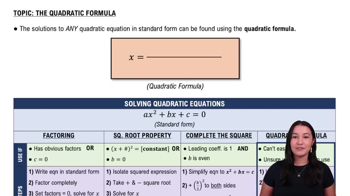
Recall the quadratic formula: \(x = \frac{-b \pm \sqrt{b^2 - 4ac}}{2a}\). This formula gives the solutions to any quadratic equation.
Substitute the values of \(a\), \(b\), and \(c\) into the quadratic formula: \(x = \frac{-(-6) \pm \sqrt{(-6)^2 - 4 \times 1 \times 7}}{2 \times 1}\).
Simplify inside the square root and the numerator step-by-step to find the two possible values of \(x\).
Verified video answer for a similar problem:This video solution was recommended by our tutors as helpful for the problem above
Video duration:
5mPlay a video:
0 Comments
Key Concepts
Here are the essential concepts you must grasp in order to answer the question correctly.
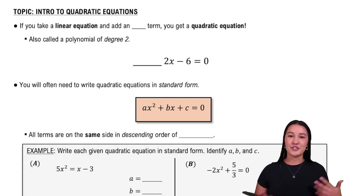
Quadratic Equation Standard Form
A quadratic equation is typically written in the standard form ax² + bx + c = 0, where a, b, and c are constants and a ≠ 0. To apply the quadratic formula, the equation must first be rearranged into this form by moving all terms to one side.
Recommended video:
Introduction to Quadratic Equations
Quadratic Formula
The quadratic formula x = (-b ± √(b² - 4ac)) / (2a) provides the solutions to any quadratic equation in standard form. It uses the coefficients a, b, and c to find the roots, including real and complex solutions depending on the discriminant.
Recommended video:
Quadratic Formula
Discriminant and Nature of Roots
The discriminant, given by b² - 4ac, determines the nature of the roots of a quadratic equation. If positive, there are two distinct real roots; if zero, one real root; and if negative, two complex conjugate roots.
Recommended video:
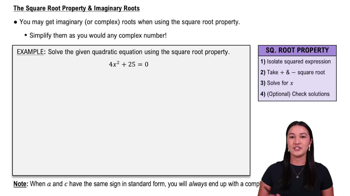
Imaginary Roots with the Square Root Property
Related Videos
Related Practice
Textbook Question
52
views