For the points P and Q, find (a) the distance d(P, Q) and (b) the coordinates of the midpoint M of line segment PQ. See Examples 1 and 2. P(-5, -6), Q(7, -1)
Ch. R - Algebra Review
Chapter 1, Problem 11
Determine whether each relation defines a function. See Example 1. {(5, 1), (3, 2), (4, 9), (7, 8)}
Verified step by step guidance1
Recall that a relation defines a function if every input (or x-value) corresponds to exactly one output (or y-value).
List the input values from the given relation: 5, 3, 4, and 7.
Check if any input value is repeated with a different output value. In this case, each input (5, 3, 4, 7) appears only once.
Since no input value is paired with more than one output value, the relation satisfies the definition of a function.
Conclude that the given relation defines a function because each input has a unique output.

Verified video answer for a similar problem:
This video solution was recommended by our tutors as helpful for the problem above.
Video duration:
2mWas this helpful?
Key Concepts
Here are the essential concepts you must grasp in order to answer the question correctly.
Definition of a Function
A function is a relation where each input (or domain element) is paired with exactly one output (or range element). This means no input value can correspond to more than one output value.
Recommended video:
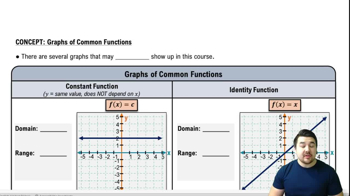
Graphs of Common Functions
Relation as a Set of Ordered Pairs
A relation is a collection of ordered pairs (x, y), where x is from the domain and y is from the range. Understanding how to interpret these pairs is essential to analyze whether the relation meets the criteria of a function.
Recommended video:
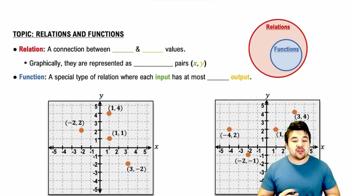
Introduction to Relations and Functions
Testing for Function Using Domain Values
To determine if a relation is a function, check if any domain value (first element in each pair) repeats with different range values. If no domain value repeats or repeats with the same range value, the relation is a function.
Recommended video:
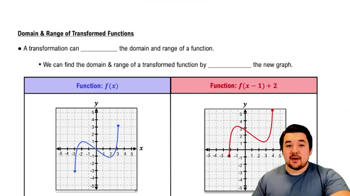
Domain and Range of Function Transformations
Related Practice
Textbook Question
520
views
Textbook Question
Find each sum or difference. See Example 1. -6 + (-13)
500
views
Textbook Question
Work each matching problem.
Match each equation in Column I with a description of its graph from Column II as it relates to the graph of y = x².
I II
a. y = (x - 7)² A. a translation to the left 7 units
b. y = x² - 7 B. a translation to the right 7 units
c. y = 7x² C. a translation up 7 units
d. y = (x + 7)² D. a translation down 7 units
e. y = x² + 7 E. a vertical stretching by a factor of 7
390
views
Textbook Question
Find the domain of each rational expression. See Example 1. (x + 3) / (x - 6)
963
views
Textbook Question
List the elements in each set. See Example 1. {x|x is a whole number less than 6}
30
views
Textbook Question
Solve each linear equation. See Examples 1–3. 7x + 8 = 1
82
views