For the points P and Q, find (a) the distance d(P, Q) and (b) the coordinates of the midpoint M of line segment PQ. See Examples 1 and 2. P(-5, -6), Q(7, -1)
Ch. R - Algebra Review
Chapter 1, Problem 13
List the elements in each set. See Example 1. {z|z is a natural number greater than 4}
Verified step by step guidance1
Understand the problem: We need to list all elements of the set defined by the condition \(z\) is a natural number greater than 4.
Recall the definition of natural numbers: Natural numbers are the set of positive integers starting from 1, i.e., \(\{1, 2, 3, 4, 5, \ldots\}\).
Apply the condition 'greater than 4' to the natural numbers: This means we consider all natural numbers \(z\) such that \(z > 4\).
Write the elements of the set starting from the smallest natural number greater than 4, which is 5, and continue listing the numbers in increasing order: \(\{5, 6, 7, 8, \ldots\}\).
Since the set includes all natural numbers greater than 4 without an upper bound, the set is infinite and can be expressed as \(\{z \in \mathbb{N} \mid z > 4\} = \{5, 6, 7, 8, \ldots\}\).

Verified video answer for a similar problem:
This video solution was recommended by our tutors as helpful for the problem above.
Video duration:
2mWas this helpful?
Key Concepts
Here are the essential concepts you must grasp in order to answer the question correctly.
Set Notation
Set notation is a way to describe a collection of elements that share a common property. In this question, the set is defined using a condition inside braces, indicating all elements z that satisfy the given property.
Recommended video:
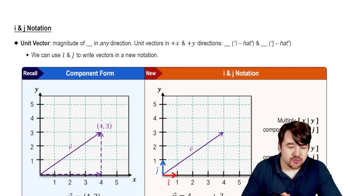
i & j Notation
Natural Numbers
Natural numbers are the set of positive integers starting from 1 (1, 2, 3, ...). Understanding this helps identify which numbers qualify as elements of the set, especially when conditions like 'greater than 4' are applied.
Recommended video:
Introduction to Complex Numbers
Inequalities in Set Definitions
Inequalities specify the range of values included in a set. Here, 'greater than 4' means all natural numbers strictly larger than 4 are included, so elements start from 5 onwards.
Recommended video:
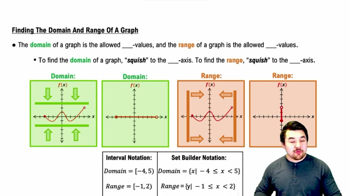
Finding the Domain and Range of a Graph
Related Practice
Textbook Question
520
views
Textbook Question
Find each sum or difference. See Example 1. -6 + (-13)
500
views
Textbook Question
Work each matching problem.
Match each equation in Column I with a description of its graph from Column II as it relates to the graph of y = x².
I II
a. y = (x - 7)² A. a translation to the left 7 units
b. y = x² - 7 B. a translation to the right 7 units
c. y = 7x² C. a translation up 7 units
d. y = (x + 7)² D. a translation down 7 units
e. y = x² + 7 E. a vertical stretching by a factor of 7
390
views
Textbook Question
Find each sum or difference. See Example 1. -15 + 6
521
views
Textbook Question
Find each square root. See Example 1. √100
963
views
Textbook Question
For the points P and Q, find (a) the distance d(P, Q) and (b) the coordinates of the midpoint M of line segment PQ. See Examples 1 and 2.
P(8, 2), Q(3, 5)
685
views