Ch. 4 - Laws of Sines and Cosines; Vectors
Blitzer - Trigonometry 3rd Edition
Blitzer3rd EditionTrigonometryISBN: 9780137316601Not the one you use?Change textbook
Chapter 4, Problem 23

In Exercises 9–24, solve each triangle. Round lengths to the nearest tenth and angle measures to the nearest degree.
a = 63, b = 22, c = 50

Verified step by step guidance
1
Identify the given elements of the triangle: sides \(a = 63\), \(b = 22\), and \(c = 50\). Since all three sides are known, this is a Side-Side-Side (SSS) case.
Use the Law of Cosines to find one of the angles. For example, to find angle \(A\) opposite side \(a\), use the formula: \[\cos(A) = \frac{b^2 + c^2 - a^2}{2bc}\]
Calculate \(\cos(A)\) by substituting the known side lengths into the formula, then find angle \(A\) by taking the inverse cosine (arccos) of that value: \[A = \cos^{-1}\left(\frac{b^2 + c^2 - a^2}{2bc}\right)\]
Once angle \(A\) is found, use the Law of Cosines again to find another angle, for example angle \(B\) opposite side \(b\): \[\cos(B) = \frac{a^2 + c^2 - b^2}{2ac}\] Then find \(B\) by taking the inverse cosine.
Finally, find the third angle \(C\) using the fact that the sum of angles in a triangle is \(180^\circ\): \[C = 180^\circ - A - B\] Round all angles to the nearest degree and all sides are already given.

Verified video answer for a similar problem:

This video solution was recommended by our tutors as helpful for the problem above.
Video duration:
8m
Was this helpful?

Key Concepts

Here are the essential concepts you must grasp in order to answer the question correctly.

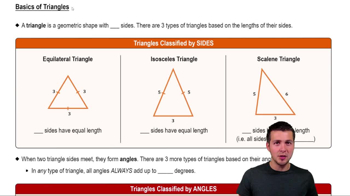
Triangle Classification and Properties

Understanding the types of triangles (scalene, isosceles, equilateral) and their properties is essential. Given three sides, the triangle inequality theorem must be checked to ensure a valid triangle exists before solving for angles.
Recommended video:
4:42
Review of Triangles

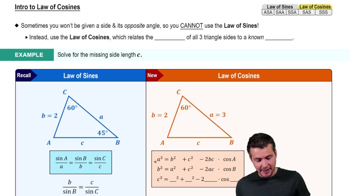
Law of Cosines

The Law of Cosines relates the lengths of sides of a triangle to the cosine of one of its angles. It is used to find unknown angles when all three sides are known, using the formula: c² = a² + b² - 2ab cos(C).
Recommended video:
4:35
Intro to Law of Cosines

Rounding and Angle Measurement

After calculating side lengths and angles, results must be rounded appropriately. Lengths are rounded to the nearest tenth, and angles to the nearest degree, ensuring answers are precise and practical for real-world applications.
Recommended video:
5:31
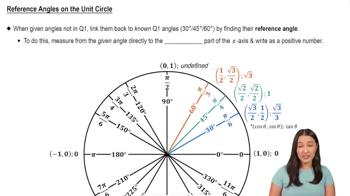
Reference Angles on the Unit Circle