Ch. 4 - Graphs of the Circular Functions
Lial - Trigonometry 12th Edition
Lial12th EditionTrigonometryISBN: 9780136552161Not the one you use?Change textbook
Chapter 5, Problem 26

Graph each function over a one-period interval.
y = -2 cos x

Verified step by step guidance
1
Identify the basic function and its characteristics. The given function is \(y = -2 \cos x\), which is a cosine function with an amplitude of 2 and a reflection about the x-axis due to the negative sign.
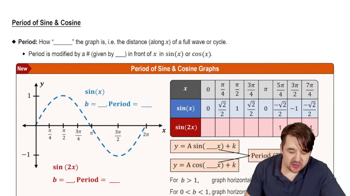
Recall the period of the cosine function. The standard cosine function \(\cos x\) has a period of \(2\pi\), so the function \(y = -2 \cos x\) will also have a period of \(2\pi\).
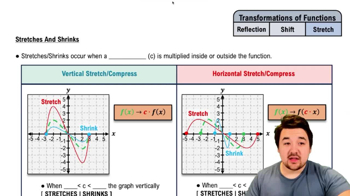
Determine the amplitude and vertical stretch. The amplitude is the absolute value of the coefficient in front of the cosine, which is \(| -2 | = 2\). This means the graph will oscillate between \(-2\) and \(2\), but reflected because of the negative sign.
Set the interval for one period. Since the period is \(2\pi\), choose the interval \([0, 2\pi]\) to graph one full cycle of the function.
Plot key points within the interval. At \(x=0\), \(y = -2 \cos 0 = -2 \times 1 = -2\). At \(x=\pi/2\), \(y = -2 \cos (\pi/2) = -2 \times 0 = 0\). At \(x=\pi\), \(y = -2 \cos \pi = -2 \times (-1) = 2\). At \(x=3\pi/2\), \(y = -2 \cos (3\pi/2) = -2 \times 0 = 0\). At \(x=2\pi\), \(y = -2 \cos (2\pi) = -2 \times 1 = -2\). Connect these points smoothly to complete the graph.

Verified video answer for a similar problem:

This video solution was recommended by our tutors as helpful for the problem above.
Was this helpful?

Key Concepts

Here are the essential concepts you must grasp in order to answer the question correctly.

Period of the Cosine Function

The period of the basic cosine function y = cos x is 2π, meaning the function repeats its values every 2π units along the x-axis. When graphing over one period, you plot the function from 0 to 2π (or any interval of length 2π) to capture one full cycle.
Recommended video:
5:33
Period of Sine and Cosine Functions

Amplitude and Vertical Stretch

The amplitude of a cosine function y = a cos x is the absolute value of a, representing the maximum distance from the midline to the peak. In y = -2 cos x, the amplitude is 2, and the negative sign reflects the graph across the x-axis, flipping the peaks and troughs.
Recommended video:
6:02
Stretches and Shrinks of Functions

Graphing Transformations of Trigonometric Functions

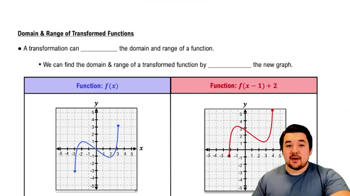
Graphing transformations include vertical shifts, stretches, and reflections. For y = -2 cos x, the negative sign causes a reflection over the x-axis, and the coefficient 2 stretches the graph vertically. Understanding these helps accurately sketch the function's shape and key points.
Recommended video:
4:22
Domain and Range of Function Transformations