Ch. 4 - Graphs of the Circular Functions
Lial - Trigonometry 12th Edition
Lial12th EditionTrigonometryISBN: 9780136552161Not the one you use?Change textbook
Chapter 5, Problem 4.23

Graph each function over a one-period interval.
y = ½ cot (4x)

Verified step by step guidance
1
Identify the basic form of the cotangent function: \( y = a \cdot \cot(bx) \). In this case, \( a = \frac{1}{2} \) and \( b = 4 \).
Determine the period of the function. The period of \( \cot(bx) \) is \( \frac{\pi}{b} \). Substitute \( b = 4 \) to find the period: \( \frac{\pi}{4} \).
Identify the vertical stretch or compression. The coefficient \( a = \frac{1}{2} \) indicates a vertical compression by a factor of \( \frac{1}{2} \).
Determine the key points for one period of the cotangent function. The cotangent function has vertical asymptotes at the beginning and end of each period, and it crosses the x-axis at the midpoint of the period.
Sketch the graph over one period \( [0, \frac{\pi}{4}] \). Plot the vertical asymptotes at \( x = 0 \) and \( x = \frac{\pi}{4} \), and the x-intercept at \( x = \frac{\pi}{8} \). Apply the vertical compression to adjust the steepness of the curve.

Verified video answer for a similar problem:

This video solution was recommended by our tutors as helpful for the problem above.
Was this helpful?

Key Concepts

Here are the essential concepts you must grasp in order to answer the question correctly.

Cotangent Function

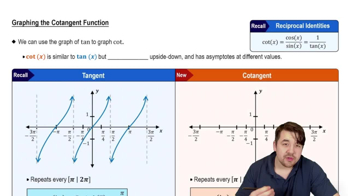
The cotangent function, denoted as cot(x), is the reciprocal of the tangent function. It is defined as cot(x) = cos(x)/sin(x). The cotangent function has a period of π, meaning it repeats its values every π units. Understanding the behavior of the cotangent function is essential for graphing it accurately.
Recommended video:
5:37
Introduction to Cotangent Graph

Period of a Function

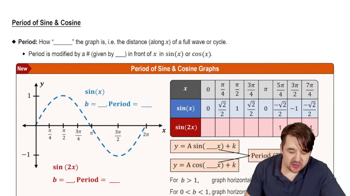
The period of a function is the length of the interval over which the function completes one full cycle. For the cotangent function, the standard period is π. However, when the function is transformed, such as in y = ½ cot(4x), the period is affected by the coefficient of x. In this case, the period becomes π/4, indicating that the function will complete one cycle in that interval.
Recommended video:
5:33
Period of Sine and Cosine Functions

Vertical Stretch

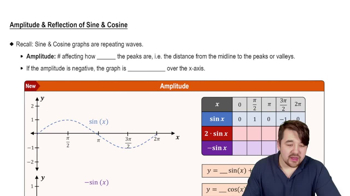
A vertical stretch occurs when a function is multiplied by a constant factor greater than one or less than one, affecting its amplitude. In the function y = ½ cot(4x), the factor of ½ indicates a vertical compression, which reduces the height of the graph by half. This transformation alters the range of the function but does not affect its period or the x-values where it is undefined.
Recommended video:
6:02
Stretches and Shrinks of Functions