For the points P and Q, find (a) the distance d(P, Q) and (b) the coordinates of the midpoint M of line segment PQ. See Examples 1 and 2. P(-5, -6), Q(7, -1)
Ch. R - Algebra Review
Chapter 1, Problem 11
List the elements in each set. See Example 1. {x|x is a whole number less than 6}
Verified step by step guidance1
Understand the problem: We need to list all elements \( x \) such that \( x \) is a whole number less than 6.
Recall the definition of whole numbers: Whole numbers are non-negative integers starting from 0, i.e., \( 0, 1, 2, 3, \ldots \).
Identify the whole numbers less than 6: These are all whole numbers \( x \) where \( x < 6 \).
List the elements: Write down all whole numbers starting from 0 up to the largest whole number less than 6.
Express the set explicitly: The set \( \{ x \mid x \text{ is a whole number less than } 6 \} \) is \( \{ 0, 1, 2, 3, 4, 5 \} \).

Verified video answer for a similar problem:
This video solution was recommended by our tutors as helpful for the problem above.
Video duration:
2mWas this helpful?
Key Concepts
Here are the essential concepts you must grasp in order to answer the question correctly.
Set Notation
Set notation is a way to describe a collection of elements that share a common property. In this question, the set is defined by a condition on its elements, using curly braces and a vertical bar to mean 'such that'. Understanding this helps identify which numbers belong to the set.
Recommended video:
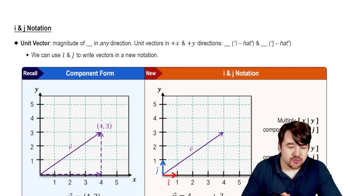
i & j Notation
Whole Numbers
Whole numbers are the set of non-negative integers starting from zero (0, 1, 2, 3, ...). Recognizing that the elements must be whole numbers restricts the possible values to these integers, excluding fractions, decimals, and negative numbers.
Recommended video:
Multiplying Complex Numbers
Inequalities and Their Interpretation
Inequalities express a range of values that satisfy a condition. Here, 'less than 6' means all whole numbers strictly smaller than 6, so elements must be less than 6 but can include zero and positive integers up to 5. Understanding inequalities helps list all valid elements.
Recommended video:
Finding the Domain and Range of a Graph
Related Practice
Textbook Question
520
views
Textbook Question
Work each matching problem.
Match each equation in Column I with a description of its graph from Column II as it relates to the graph of y = x².
I II
a. y = (x - 7)² A. a translation to the left 7 units
b. y = x² - 7 B. a translation to the right 7 units
c. y = 7x² C. a translation up 7 units
d. y = (x + 7)² D. a translation down 7 units
e. y = x² + 7 E. a vertical stretching by a factor of 7
390
views
Textbook Question
CONCEPT PREVIEW Perform the operations mentally, and write the answers without doing intermediate steps. (√28 - √14) (√28 + √14)
1023
views
Textbook Question
Find the domain of each rational expression. See Example 1. (x + 3) / (x - 6)
963
views
Textbook Question
Determine whether each relation defines a function. See Example 1. {(5, 1), (3, 2), (4, 9), (7, 8)}
508
views
Textbook Question
Solve each linear equation. See Examples 1–3. 7x + 8 = 1
82
views