If θ is an acute angle and sin θ = (2√7) / 7, use the identity sin²θ + cos²θ = 1 to find cos θ.
Table of contents
- 0. Review of College Algebra4h 45m
- 1. Measuring Angles40m
- 2. Trigonometric Functions on Right Triangles2h 5m
- 3. Unit Circle1h 19m
- 4. Graphing Trigonometric Functions1h 19m
- 5. Inverse Trigonometric Functions and Basic Trigonometric Equations1h 41m
- 6. Trigonometric Identities and More Equations2h 34m
- 7. Non-Right Triangles1h 38m
- 8. Vectors2h 25m
- 9. Polar Equations2h 5m
- 10. Parametric Equations1h 6m
- 11. Graphing Complex Numbers1h 7m
6. Trigonometric Identities and More Equations
Introduction to Trigonometric Identities
Problem 72
Textbook Question
In Exercises 67–74, rewrite each expression in terms of the given function or functions. (sec x + csc x) (sin x + cos x) - 2 - cot x; tan x
Verified step by step guidance1
Identify the given expression: \( (\sec x + \csc x)(\sin x + \cos x) - 2 - \cot x \) and the function to express it in terms of: \( \tan x \).
Recall the definitions of the trigonometric functions involved: \( \sec x = \frac{1}{\cos x} \), \( \csc x = \frac{1}{\sin x} \), and \( \cot x = \frac{\cos x}{\sin x} \).
Expand the product \( (\sec x + \csc x)(\sin x + \cos x) \) by distributing each term:
\( \sec x \cdot \sin x + \sec x \cdot \cos x + \csc x \cdot \sin x + \csc x \cdot \cos x \).
Substitute the definitions into each term and simplify where possible, for example, \( \sec x \cdot \sin x = \frac{\sin x}{\cos x} = \tan x \), and \( \csc x \cdot \sin x = 1 \).
Combine all simplified terms, subtract 2 and \( \cot x \), then rewrite any remaining expressions in terms of \( \tan x \) using identities such as \( \cot x = \frac{1}{\tan x} \) to express the entire expression solely in terms of \( \tan x \).
Verified video answer for a similar problem:This video solution was recommended by our tutors as helpful for the problem above
Video duration:
5mPlay a video:
0 Comments
Key Concepts
Here are the essential concepts you must grasp in order to answer the question correctly.
Reciprocal Trigonometric Functions
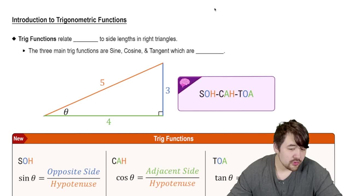
Reciprocal functions are the inverses of the basic sine, cosine, and tangent functions. Secant (sec x) is 1/cos x, cosecant (csc x) is 1/sin x, and cotangent (cot x) is 1/tan x. Understanding these allows rewriting expressions involving sec, csc, and cot in terms of sine, cosine, or tangent.
Recommended video:
Introduction to Trigonometric Functions
Algebraic Manipulation of Trigonometric Expressions
Simplifying trigonometric expressions often requires factoring, expanding, and combining like terms. Recognizing common denominators and using identities helps rewrite complex expressions in terms of specified functions, such as expressing everything in terms of tan x or sin x and cos x.
Recommended video:
Simplifying Trig Expressions
Pythagorean and Quotient Identities
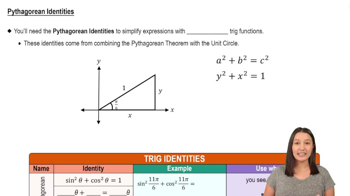
Pythagorean identities like sin²x + cos²x = 1 and quotient identities such as tan x = sin x / cos x are essential tools. They enable conversion between different trigonometric functions and simplify expressions by substituting equivalent forms.
Recommended video:
Pythagorean Identities
Related Videos
Related Practice
Textbook Question
644
views