Ch. 3 - Trigonometric Identities and Equations
Blitzer - Trigonometry 3rd Edition
Blitzer3rd EditionTrigonometryISBN: 9780137316601Not the one you use?Change textbook
Chapter 3, Problem 73

In Exercises 63–84, use an identity to solve each equation on the interval [0, 2𝝅). cos 2x + 5 cos x + 3 = 0

Verified step by step guidance
1
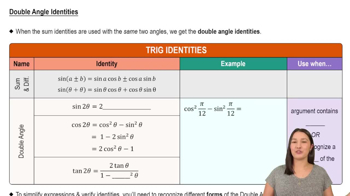
Recognize that the equation involves \( \cos 2x \) and \( \cos x \). Use the double-angle identity for cosine: \( \cos 2x = 2\cos^2 x - 1 \).
Substitute \( \cos 2x \) in the equation with the identity to rewrite the equation entirely in terms of \( \cos x \): \( 2\cos^2 x - 1 + 5\cos x + 3 = 0 \).
Simplify the equation by combining like terms: \( 2\cos^2 x + 5\cos x + 2 = 0 \).
Let \( y = \cos x \) to transform the trigonometric equation into a quadratic equation: \( 2y^2 + 5y + 2 = 0 \).
Solve the quadratic equation for \( y \) using the quadratic formula \( y = \frac{-b \pm \sqrt{b^2 - 4ac}}{2a} \), then find all \( x \) in \( [0, 2\pi) \) such that \( \cos x = y \).

Verified video answer for a similar problem:

This video solution was recommended by our tutors as helpful for the problem above.
Video duration:
4m
Was this helpful?

Key Concepts

Here are the essential concepts you must grasp in order to answer the question correctly.

Double-Angle Identity for Cosine

The double-angle identity expresses cos(2x) in terms of cos(x) or sin(x). Common forms include cos(2x) = 2cosΒ²(x) - 1 or cos(2x) = 1 - 2sinΒ²(x). This identity allows rewriting the equation to involve only one trigonometric function, simplifying the solving process.
Recommended video:
05:06
Double Angle Identities

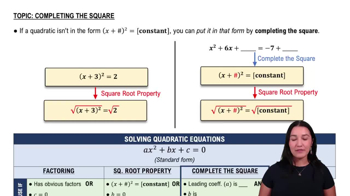
Solving Quadratic Trigonometric Equations

After applying identities, the equation often becomes quadratic in terms of cos(x) or sin(x). Solving involves treating the trigonometric function as a variable, factoring or using the quadratic formula, and then finding all angle solutions within the given interval.
Recommended video:
6:24
Solving Quadratic Equations by Completing the Square

Finding Solutions on a Specified Interval

Trigonometric equations can have multiple solutions within an interval like [0, 2Ο€). It is essential to find all angles that satisfy the equation in this range, considering the periodicity of cosine and verifying each solution to ensure it lies within the interval.
Recommended video:
3:43
Finding the Domain of an Equation