Ch. 2 - Graphs of the Trigonometric Functions; Inverse Trigonometric Functions
Blitzer - Trigonometry 3rd Edition
Blitzer3rd EditionTrigonometryISBN: 9780137316601Not the one you use?Change textbook
Chapter 2, Problem 49

In Exercises 45–52, graph two periods of each function. y = csc|x|

Verified step by step guidance
1
Understand the function given: \(y = \csc|x|\). This means the cosecant function is applied to the absolute value of \(x\). Recall that \(\csc \theta = \frac{1}{\sin \theta}\), so the function is undefined where \(\sin|x| = 0\).
Identify the domain restrictions: Since \(\sin|x| = 0\) at \(|x| = n\pi\) for integers \(n\), the function \(y = \csc|x|\) will have vertical asymptotes at \(x = 0, \pm \pi, \pm 2\pi, \pm 3\pi, \ldots\).
Determine the period of the function: The basic \(\csc x\) function has period \(2\pi\), but because of the absolute value inside, the function is symmetric about the y-axis and the period effectively becomes \(\pi\). So, two periods correspond to an interval of length \(2\pi\) on the positive side, and by symmetry, also on the negative side.
Sketch the graph over two periods: For \(x \geq 0\), plot \(y = \csc x\) from \(0\) to \(2\pi\) (excluding points where \(\sin x = 0\)). For \(x < 0\), use the symmetry \(y = \csc|x| = \csc(-x) = \csc x\) to reflect the graph about the y-axis.
Mark vertical asymptotes at \(x = 0, \pm \pi, \pm 2\pi\) and plot the characteristic 'cosecant' curves between these asymptotes, noting that the function values go to \(\pm \infty\) near the asymptotes and have minimum or maximum values at points where \(\sin|x|\) is \(\pm 1\).

Verified video answer for a similar problem:

This video solution was recommended by our tutors as helpful for the problem above.
Video duration:
4m
Was this helpful?

Key Concepts

Here are the essential concepts you must grasp in order to answer the question correctly.

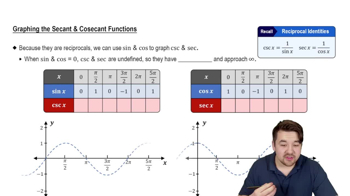
Understanding the Cosecant Function (csc x)

The cosecant function is the reciprocal of the sine function, defined as csc x = 1/sin x. It is undefined where sin x = 0, leading to vertical asymptotes at these points. Its graph features repeating branches with peaks and troughs corresponding to the sine wave's zeros and extrema.
Recommended video:
6:22
Graphs of Secant and Cosecant Functions

Effect of the Absolute Value on the Input (|x|)

Applying the absolute value to the input, as in csc|x|, reflects the function's behavior symmetrically about the y-axis. This means the graph for negative x mirrors the positive side, altering the domain and shape by folding the function over the y-axis.
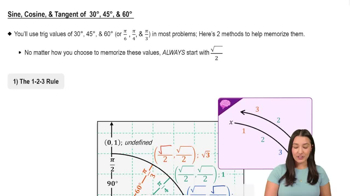
Recommended video:
5:08
Sine, Cosine, & Tangent of 30°, 45°, & 60°

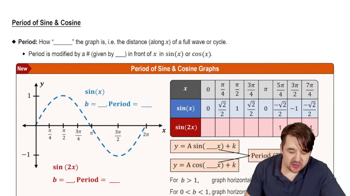
Periodicity and Graphing Multiple Periods

The period of the basic cosecant function is 2π, meaning its pattern repeats every 2π units. Graphing two periods involves plotting the function from 0 to 4π (or -2π to 2π), showing two full cycles of the wave and its asymptotes, which helps visualize the function's repeating nature.
Recommended video:
5:33
Period of Sine and Cosine Functions