Ch. 5 - Trigonometric Identities
Lial - Trigonometry 12th Edition
Lial12th EditionTrigonometryISBN: 9780136552161Not the one you use?Change textbook
Chapter 6, Problem 46

Simplify each expression. See Example 4.
⅛ sin 29.5° cos 29.5°

Verified step by step guidance
1
Recognize that the expression involves the product of sine and cosine of the same angle: \(\frac{1}{8} \sin 29.5^\circ \cos 29.5^\circ\).
Recall the double-angle identity for sine: \(\sin 2\theta = 2 \sin \theta \cos \theta\). This allows us to rewrite the product \(\sin \theta \cos \theta\) as \(\frac{1}{2} \sin 2\theta\).
Apply this identity to the expression: replace \(\sin 29.5^\circ \cos 29.5^\circ\) with \(\frac{1}{2} \sin (2 \times 29.5^\circ)\), which simplifies to \(\frac{1}{2} \sin 59^\circ\).
Substitute back into the original expression: \(\frac{1}{8} \times \frac{1}{2} \sin 59^\circ\).
Combine the constants: multiply \(\frac{1}{8}\) and \(\frac{1}{2}\) to get \(\frac{1}{16}\), so the simplified expression is \(\frac{1}{16} \sin 59^\circ\).

Verified video answer for a similar problem:

This video solution was recommended by our tutors as helpful for the problem above.
Was this helpful?

Key Concepts

Here are the essential concepts you must grasp in order to answer the question correctly.

Basic Trigonometric Functions

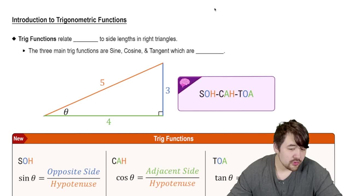
Sine and cosine are fundamental trigonometric functions that relate the angles of a right triangle to the ratios of its sides. Understanding their values and properties is essential for simplifying expressions involving these functions.
Recommended video:
6:04
Introduction to Trigonometric Functions

Product-to-Sum Identities

Product-to-sum identities transform products of sine and cosine into sums or differences of trigonometric functions. For example, sin A cos B can be rewritten as ½ [sin(A + B) + sin(A - B)], which simplifies calculations and expressions.
Recommended video:
2:25
Verifying Identities with Sum and Difference Formulas

Angle Measurement and Degree Conversion

Trigonometric functions often require angle inputs in degrees or radians. Knowing how to interpret and convert these measurements ensures accurate evaluation and simplification of expressions involving specific angle values.
Recommended video:
5:31
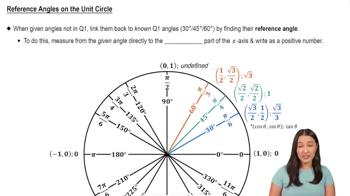
Reference Angles on the Unit Circle