Ch. 2 - Acute Angles and Right Triangles
Lial - Trigonometry 12th Edition
Lial12th EditionTrigonometryISBN: 9780136552161Not the one you use?Change textbook
Chapter 3, Problem 69

Concept Check Work each problem. What angle does the line y = √3x make with the positive x-axis?

Verified step by step guidance
1
Recall that the slope of a line, given by \(m\), is related to the angle \(\theta\) it makes with the positive x-axis by the formula \(m = \tan(\theta)\).
Identify the slope \(m\) from the given line equation \(y = \sqrt{3}x\). Here, the slope \(m = \sqrt{3}\).
Set up the equation \(\tan(\theta) = \sqrt{3}\) to find the angle \(\theta\).
Use the inverse tangent function to express the angle: \(\theta = \tan^{-1}(\sqrt{3})\).
Recall or determine the angle whose tangent is \(\sqrt{3}\), which corresponds to a common special angle in trigonometry.

Verified video answer for a similar problem:

This video solution was recommended by our tutors as helpful for the problem above.
Video duration:
3m
Was this helpful?

Key Concepts

Here are the essential concepts you must grasp in order to answer the question correctly.

Slope and Angle Relationship

The slope of a line in the coordinate plane is the tangent of the angle it makes with the positive x-axis. If the slope is m, then the angle θ satisfies tan(θ) = m. This relationship allows us to find the angle from the slope using inverse trigonometric functions.
Recommended video:
04:46
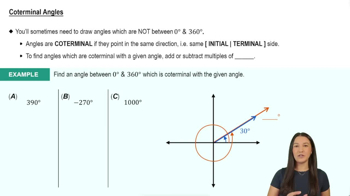
Coterminal Angles

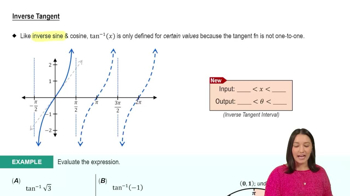
Inverse Tangent Function (arctan)

The inverse tangent function, arctan or tan⁻¹, is used to find the angle whose tangent is a given number. For a slope m, θ = arctan(m) gives the angle between the line and the positive x-axis, typically measured in degrees or radians.
Recommended video:
3:17
Inverse Tangent

Coordinate Geometry of Lines

A line in the plane can be expressed as y = mx + b, where m is the slope. Understanding how the slope relates to the line's inclination helps in interpreting geometric properties, such as the angle with the x-axis, which is essential for solving problems involving line orientation.
Recommended video:
05:32
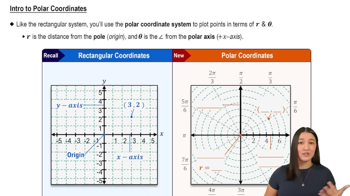
Intro to Polar Coordinates