Textbook Question
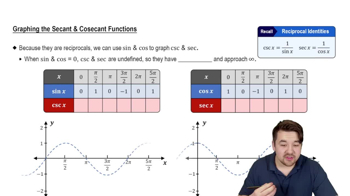
In Exercises 25–28, use each graph to obtain the graph of the corresponding reciprocal function, cosecant or secant. Give the equation of the function for the graph that you obtain.
781
views

 Blitzer 3rd EditionCh. 2 - Graphs of the Trigonometric Functions; Inverse Trigonometric FunctionsProblem 25
 Verified step by step guidance
 6:22
6:22 6:22
6:22 3:48
3:48In Exercises 25–28, use each graph to obtain the graph of the corresponding reciprocal function, cosecant or secant. Give the equation of the function for the graph that you obtain.
In Exercises 21–28, an object moves in simple harmonic motion described by the given equation, where t is measured in seconds and d in inches. In each exercise, find the following: a. the maximum displacement b. the frequency c. the time required for one cycle. d = 1/3 sin 2t
In Exercises 17–30, determine the amplitude, period, and phase shift of each function. Then graph one period of the function. y = −2 sin(2x + π/2)
In Exercises 21–28, an object moves in simple harmonic motion described by the given equation, where t is measured in seconds and d in inches. In each exercise, find the following: a. the maximum displacement b. the frequency c. the time required for one cycle. d = −8 cos π/2 t
Determine the amplitude, period, and phase shift of each function. Then graph one period of the function.
y = 1/2 sin(x + π)
Use each graph to obtain the graph of the corresponding reciprocal function, cosecant or secant. Give the equation of the function for the graph that you obtain.
<IMAGE>