Ch. 3 - Trigonometric Identities and Equations
Blitzer - Trigonometry 3rd Edition
Blitzer3rd EditionTrigonometryISBN: 9780137316601Not the one you use?Change textbook
Chapter 3, Problem 14

Use a sum or difference formula to find the exact value of each expression. cos(45° + 30°)

Verified step by step guidance
1
Identify the formula to use: Since the expression is \( \cos(45^\circ + 30^\circ) \), we use the cosine sum formula, which is \( \cos(A + B) = \cos A \cos B - \sin A \sin B \).
Assign the angles: Let \( A = 45^\circ \) and \( B = 30^\circ \).
Write the expression using the formula: \( \cos(45^\circ + 30^\circ) = \cos 45^\circ \cos 30^\circ - \sin 45^\circ \sin 30^\circ \).
Recall the exact values of the trigonometric functions: \( \cos 45^\circ = \frac{\sqrt{2}}{2} \), \( \cos 30^\circ = \frac{\sqrt{3}}{2} \), \( \sin 45^\circ = \frac{\sqrt{2}}{2} \), and \( \sin 30^\circ = \frac{1}{2} \).
Substitute these values into the expression and simplify step-by-step to find the exact value.

Verified video answer for a similar problem:

This video solution was recommended by our tutors as helpful for the problem above.
Video duration:
4m
Was this helpful?

Key Concepts

Here are the essential concepts you must grasp in order to answer the question correctly.

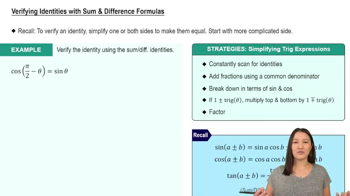
Sum and Difference Formulas for Cosine

These formulas allow you to find the cosine of the sum or difference of two angles. Specifically, cos(A + B) = cos A cos B - sin A sin B, which helps compute exact values without a calculator.
Recommended video:
2:25
Verifying Identities with Sum and Difference Formulas

Exact Values of Common Angles

Knowing the exact sine and cosine values for standard angles like 30° and 45° is essential. For example, cos 30° = √3/2 and sin 45° = √2/2, which are used directly in the sum formula.
Recommended video:
3:47
Introduction to Common Polar Equations

Trigonometric Function Properties

Understanding the behavior and relationships of sine and cosine functions, such as their ranges and symmetry, aids in correctly applying formulas and simplifying results.
Recommended video:
6:04
Introduction to Trigonometric Functions