Ch. 1 - Trigonometric Functions
Lial - Trigonometry 12th Edition
Lial12th EditionTrigonometryISBN: 9780136552161Not the one you use?Change textbook
Chapter 2, Problem 100

If n is an integer, n • 180° represents an integer multiple of 180°, (2n + 1) • 90° represents an odd integer multiple of 90° , and so on. Determine whether each expression is equal to 0, 1, or ―1, or is undefined. sin[n • 180°]

Verified step by step guidance
1
Recall the general behavior of the sine function: \(\sin(\theta)\) equals 0 whenever \(\theta\) is an integer multiple of \(180^\circ\), i.e., \(\theta = k \times 180^\circ\) for any integer \(k\).
Given the expression \(\sin[n \cdot 180^\circ]\), recognize that \(n\) is an integer, so the angle is exactly an integer multiple of \(180^\circ\).
Use the property of sine at these angles: \(\sin(k \times 180^\circ) = 0\) for all integers \(k\).
Therefore, \(\sin[n \cdot 180^\circ]\) must be equal to 0 for any integer \(n\).
No undefined values or other outputs (like 1 or -1) occur for this expression because sine is defined for all real numbers and specifically zero at these multiples.

Verified video answer for a similar problem:

This video solution was recommended by our tutors as helpful for the problem above.
Video duration:
3m

Key Concepts

Here are the essential concepts you must grasp in order to answer the question correctly.

Sine Function and Its Periodicity

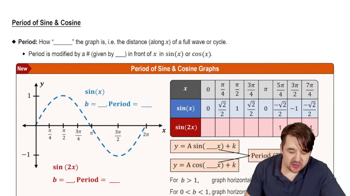
The sine function is periodic with a period of 360°, meaning sin(θ) = sin(θ + 360°k) for any integer k. This periodicity helps simplify angles by reducing them modulo 360°, making it easier to evaluate sine values for large or multiple-angle expressions.
Recommended video:
5:33
Period of Sine and Cosine Functions

Sine of Integer Multiples of 180°

For any integer n, sin(n • 180°) equals zero because 180° corresponds to π radians, where the sine function crosses the x-axis. Thus, sin(n • 180°) = 0 for all integers n, reflecting the zeros of the sine wave at these points.
Recommended video:
Guided course
4:27
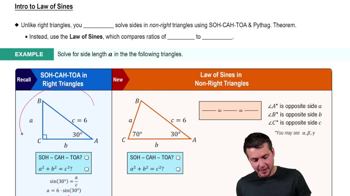
Intro to Law of Sines

Angle Representation in Degrees and Radians

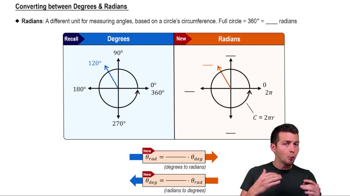
Angles can be expressed in degrees or radians, with 180° equal to π radians. Understanding this conversion is essential for interpreting trigonometric expressions and applying known sine values at key angles, such as multiples of 90° or 180°.
Recommended video:
Guided course
5:04
Converting between Degrees & Radians