Ch. 4 - Graphs of the Circular Functions
Lial - Trigonometry 12th Edition
Lial12th EditionTrigonometryISBN: 9780136552161Not the one you use?Change textbook
Chapter 5, Problem 61

Consider the following function from Example 5. Work these exercises in order.
y = -2 - cot (x - π/4)
Use the fact that the period of this function is π to find the next positive x-intercept. Round to the nearest hundredth.

Verified step by step guidance
1
Identify the given function: \(y = -2 - \cot\left(x - \frac{\pi}{4}\right)\). We want to find the x-intercepts, where \(y = 0\).
Set the function equal to zero to find the x-intercepts: \(0 = -2 - \cot\left(x - \frac{\pi}{4}\right)\).
Rearrange the equation to isolate the cotangent term: \(\cot\left(x - \frac{\pi}{4}\right) = -2\).
Recall that the cotangent function has a period of \(\pi\), so the general solution for \(\cot \theta = -2\) is \(\theta = \cot^{-1}(-2) + k\pi\), where \(k\) is any integer.
Substitute back \(\theta = x - \frac{\pi}{4}\) and solve for \(x\): \(x = \cot^{-1}(-2) + \frac{\pi}{4} + k\pi\). Use the smallest positive \(x\)-intercept found (for some integer \(k\)) and then add the period \(\pi\) to find the next positive x-intercept. Round your answer to the nearest hundredth.

Verified video answer for a similar problem:

This video solution was recommended by our tutors as helpful for the problem above.
Was this helpful?

Key Concepts

Here are the essential concepts you must grasp in order to answer the question correctly.

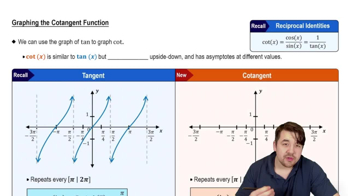
Cotangent Function and Its Properties

The cotangent function, cot(x), is the reciprocal of the tangent function and is defined as cos(x)/sin(x). It has vertical asymptotes where sin(x) = 0 and zeros where cos(x) = 0. Understanding its behavior and graph is essential for identifying intercepts and transformations.
Recommended video:
5:37
Introduction to Cotangent Graph

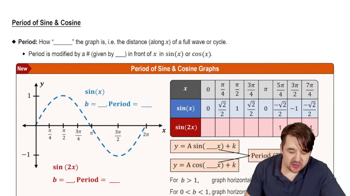
Period of Trigonometric Functions

The period of a trigonometric function is the length of one complete cycle before the function repeats. For cotangent, the standard period is π. When the function is transformed, such as cot(x - π/4), the period remains π, which helps in finding subsequent intercepts by adding multiples of the period.
Recommended video:
5:33
Period of Sine and Cosine Functions

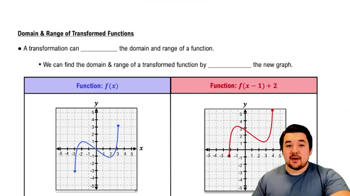
Finding X-Intercepts of Transformed Functions

X-intercepts occur where the function equals zero. For y = -2 - cot(x - π/4), set y = 0 and solve for x. This involves isolating cot(x - π/4) and using the periodicity to find the next positive solution, then rounding the result as required.
Recommended video:
4:22
Domain and Range of Function Transformations