Mastering fluency through explicit, structured routines


Summary:
- Reading fluency is the ability to read accurately, smoothly, and with expression, enabling students to focus on meaning rather than decoding
- Fluency acts as the critical bridge between word recognition and comprehension, supporting deeper understanding of texts
- Structured 15-minute daily routines help build fluency through modelling, guided practice, and independent repeated reading
- Repeated reading strengthens automatic word recognition, allowing students to read more confidently and with greater ease
- Explicit, consistent instruction significantly improves reading outcomes, particularly from Year 2 through to upper primary
- Resources to support fluency include StepsWeb and OxEd & Assessment
In primary literacy, successful reading involves more than accurate decoding. For school leaders looking to secure long-term academic outcomes, ensuring students develop reading fluency is a critical priority often in Year 2, and beyond. Students must read with sufficient ease and expression to engage with meaning across sentences and texts. While early phonics instruction supports word recognition, challenges often emerge as texts become longer and more complex.
Pearson research indicates that many educators identify fluency as a key point of difficulty, particularly in its relationship to comprehension (Pearson Australia Market Research Report, Pearson Australia, 2026). When reading remains effortful, students may read accurately but struggle to construct meaning, as cognitive effort is directed entirely towards decoding rather than interpretation.
For this reason, fluency benefits from being addressed by leadership as a deliberate, purposeful, and structured element of literacy instruction, rather than an assumed outcome of independent practice. Optimising this process is essential for building the neurological architecture required for lifelong literacy; indeed, most literate adults possess a permanent store of 30,000 to 70,000 words in their brain's Visual Word Form Area (Essentials of Assessing, Preventing, and Overcoming Reading Difficulties, Kilpatrick, 2015).
Fluency and the transition to comprehension
Fluency sits at the intersection of word recognition and language comprehension, acting as the critical "bridge" that weaves these components together, as illustrated in Scarborough’s Reading Rope (Connecting early language and literacy to later reading (dis)abilities: Evidence, theory, and practice, Scarborough, 2001).
Fluency falls directly into the category of orthographic mapping—the mental process readers use to turn unfamiliar words into instantly recognizable sight words. When students read with increasing automaticity, they are better able to allocate finite working memory to meaning, vocabulary, and ideas within the text (Why Reading Fluency Should be Hot, Rasinski, 2012). In this sense, fluency supports comprehension not as a separate skill, but as a neurological condition that makes comprehension possible.
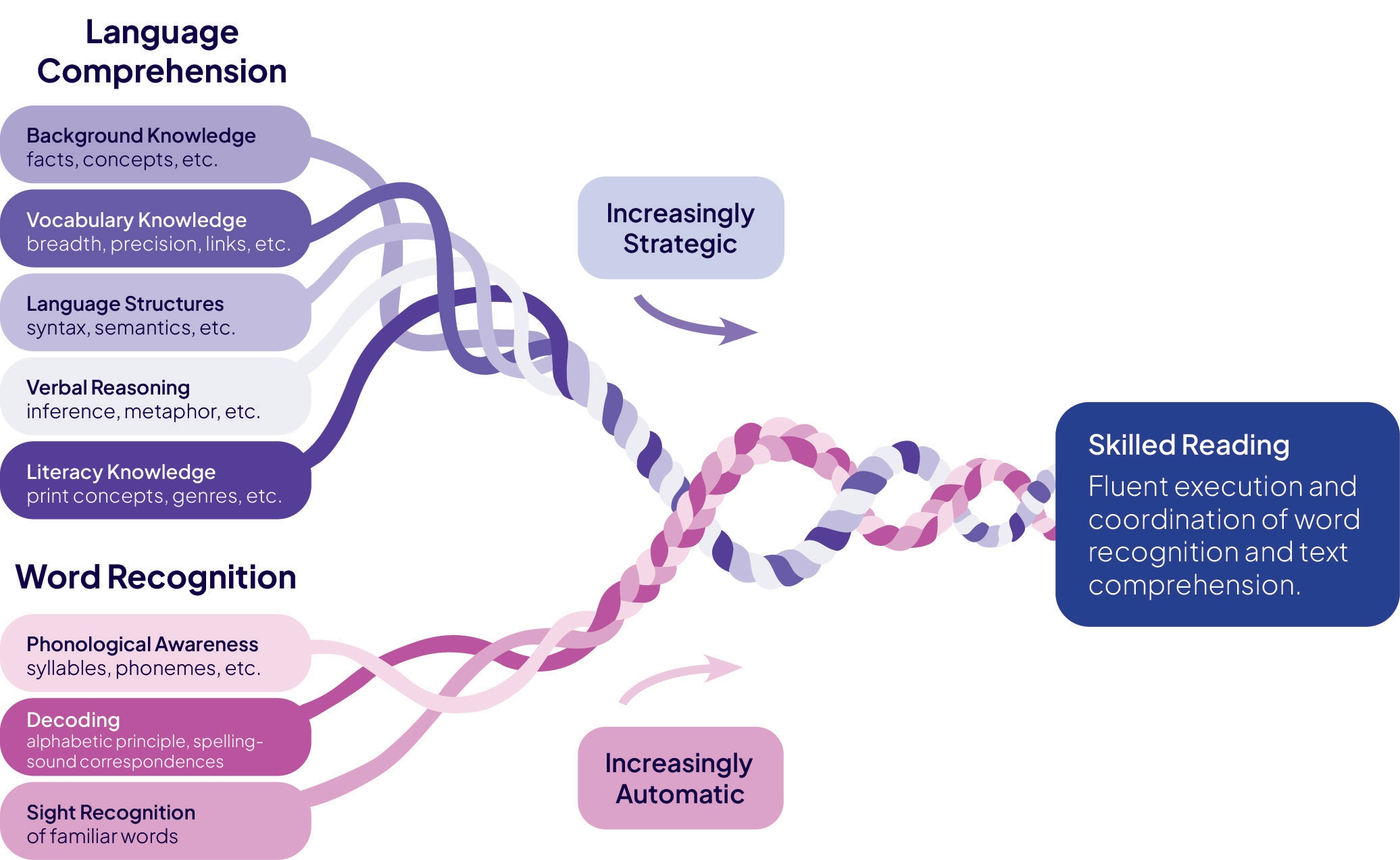
Diagram: Scarborough’s Reading Rope
Structuring fluency instruction within limited time
Within a crowded literacy block, fluency instruction is most effective when it is brief, consistent, and exceptionally well-organized. Short, 10-to-15-minute daily routines allow students to practise reading behaviours regularly without displacing other areas of instruction.
While the foundations of fluency are seeded in Year 1 through decodable texts, this dedicated routine is ideally targeted from Year 2 through to Year 6. In Year 2, it serves as the critical transition point where students move away from overt word-by-word blending into structural phrasing. In Years 3 to 6, the exact same 15-minute structure is maintained, but the cognitive demand shifts to help students navigate the complex syntax and dense vocabulary of tier-2 and tier-3 authentic texts.
The most effective framework for this work is the Gradual Release of Responsibility, or the "I Do, We Do, You Do" model. This framework supports explicit teaching by clearly sequencing modelling, supported practice, and independent application, providing a highly scalable model for whole-school implementation (Explicit Instruction: Efficient and Effective Teaching, Archer & Hughes, 2011).
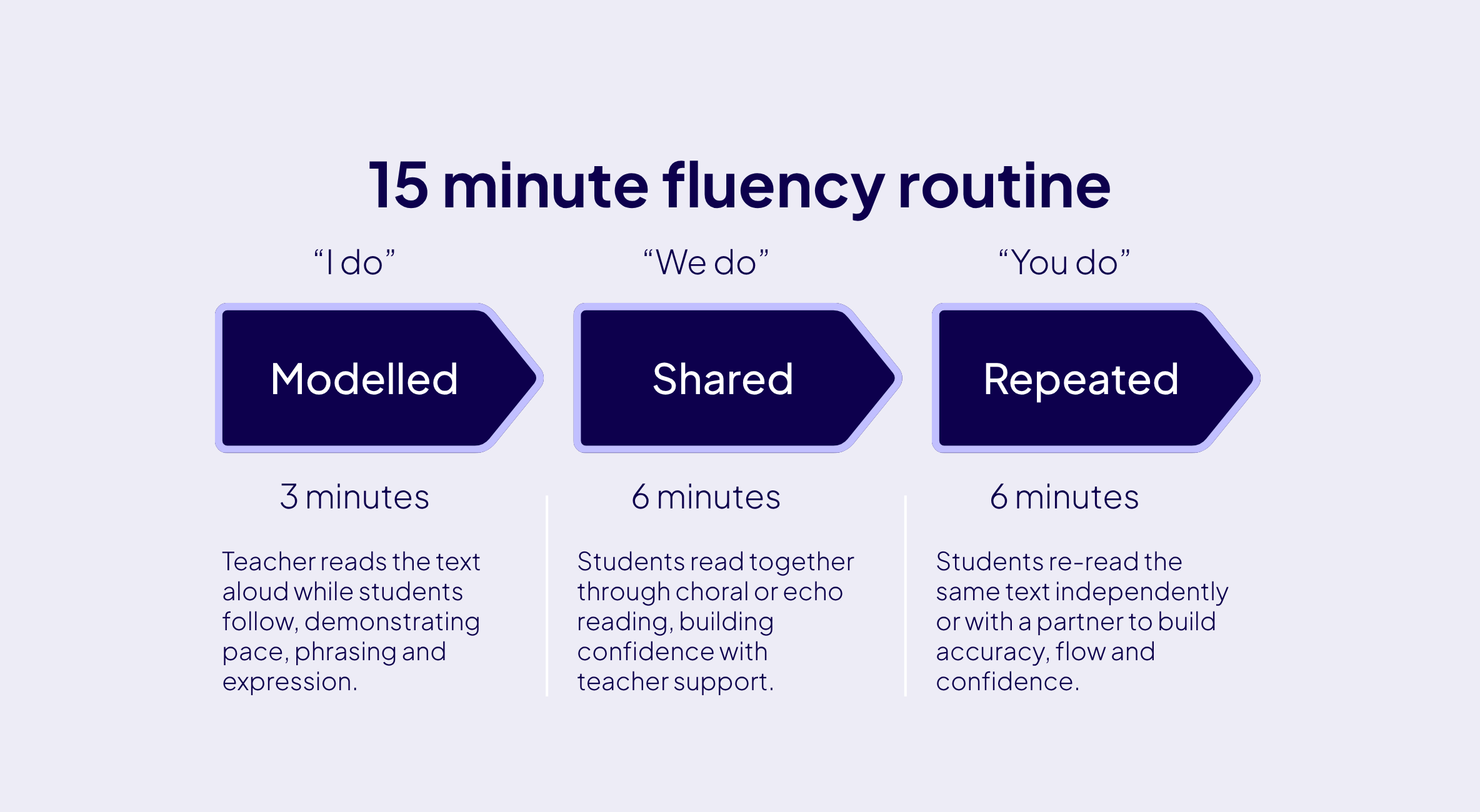
Diagram: A structured 15 minute fluency routine based on the Gradual Release of Responsibility.
I Do: Modelling fluent reading (3 minutes)
The routine begins with explicit teacher modelling, utilizing rich read-alouds to leverage the inter-related nature of fluency and oral language. The teacher reads a short, purposefully selected passage aloud, demonstrating the three core pillars of fluency: speed, accuracy, and prosody (phrasing, pacing, and expression).
This modelling establishes an auditory reference point. By hearing fluent reading, students are exposed to how oral language structures, punctuation, and intonation directly support meaning across sentences.
We Do: Supported shared practice (5 minutes)
Following modelling, students engage in guided, shared reading activities, such as choral or echo reading, which provide a strong oral language scaffold to lift reading skills.
Shared practice reduces performance pressure and allows all students to actively participate. At this stage, support remains audible and visible, helping students consolidate reading behaviours. These strategies are used most heavily at the start of the week when a text is unfamiliar; as the week progresses and confidence grows, the teacher’s vocal support is gradually withdrawn.
You Do: Repeated and deliberate partner reading (7 minutes)
As familiarity with the text develops, students move into independent application. Rather than unstructured independent reading, this phase relies on deliberately matched fluency partners engaging in repeated reading.
Repeated reading of the same text is the gold standard for strengthening accuracy and smoothness, allowing word recognition to become entirely automatic (The method of repeated readings, Samuels, 1979; Oral Reading Fluency as an Indicator of Reading Proficiency, Fuchs et al., 2001).
Crucially, this phase is where orthographic mapping occurs:
- Neurotypical readers (Year 3 onwards): Once they possess foundational orthographic mapping skills, they only need to see and read a printed word 1 to 4 times before it is permanently stored as a sight word (Effects of Oral and Silent Reading Practices on the Reading Process, Reitsma, 1983; Kilpatrick, 2015).
- For students with dyslexia, word learning is often less efficient because the phonological skills that underpin orthographic mapping are compromised. As a result, they typically need many more successful exposures and greater cumulative practice for words to become instantly recognisable (Essentials of Assessing, Preventing, and Overcoming Reading Difficulties, Kilpatrick, 2015)
A structured, repetitive daily routine ensures that vulnerable readers receive the high-frequency exposure they require for equity of opportunity.
Purposeful text selection across grade levels
To maximize impact, reading passages must be selected with clear pedagogical purpose and directly reinforce what is currently being taught in the broader literacy block. Schools should implement a clear progression:
- Early Readers: Must use highly structured decodable texts strictly aligned to their current grapheme-phoneme correspondence (phonics) knowledge.
- Older Students: Transition to authentic, knowledge-rich texts.
Across all year levels, texts must be carefully calibrated: they must be challenging enough to extend students' vocabulary and syntactic knowledge, but not so difficult that they disrupt fluency and fracture comprehension.
Factors that can reduce impact
To ensure this routine scales successfully across classrooms, leadership should monitor and eliminate certain counter-productive patterns, including:
- Frequent changes of text: Moving to a new text too quickly eliminates the compounding benefits of repetition and halts orthographic mapping.
- Heavy reliance on silent reading: Silent reading acts as an unmonitored "black box" that limits vital teacher modelling and immediate peer feedback.
- Over-correction: Frequent verbal interruptions during reading disrupt the physical flow and damage reader confidence.
Considering fluency alongside comprehension
Fluency and comprehension are intrinsically connected from the earliest stages of reading, beginning at the single-word level in Foundation and scaffolding upward as text complexity grows. When a student reads with appropriate prosody, they are actively demonstrating their interpretation of the text as they are reading it.
However, they do not always need to be taught simultaneously. In a sharp, 15-minute routine, the emphasis remains on reading accuracy, flow, and expression. Brief checks for understanding can support phrasing, but extended comprehension discussions sit more effectively elsewhere in the literacy block so as not to reduce the momentum or impact of the fluency sprint.
Building fluency over time
FFor school leaders, developing fluency is not about increasing instructional load or adding complexity to a teacher's day. It is about allocating a short block of time with greater consistency, deliberate structure, and research-backed purpose. When fluency practice is systematically embedded across all classrooms, students are given the ultimate tool to transition seamlessly from decoding words to understanding texts.
Sources & Further Reading:
- Archer, A. L., & Hughes, C. A. (2011). Explicit Instruction: Efficient and Effective Teaching. (Guilford Press).
- Bateman, B. (1991). "An Emphasized Whole-Word Approach to Remedial Reading." (Focal Point).
- Fuchs, L. S., Fuchs, D., Hosp, M. K., & Jenkins, J. R. (2001). "Oral Reading Fluency as an Indicator of Reading Proficiency." (Scientific Studies of Reading).
- Kilpatrick, D. (2015). Essentials of Assessing, Preventing, and Overcoming Reading Difficulties. (Wiley).
- Pearson Australia. (2026). Primary Literacy Instructional Challenges: Primary Educator Market Research Report.
- Rasinski, T. (2012). "Why Reading Fluency Should be Hot." (The Reading Teacher).
- Reitsma, P. (1983). "Printed word learning in beginning readers." (Journal of Experimental Child Psychology).
- Samuels, S. J. (1979). "The method of repeated readings." (The Reading Teacher).
- Scarborough, H. S. (2001). "Connecting early language and literacy to later reading (dis)abilities: Evidence, theory, and practice." (Handbook of Early Literacy Research).
See how Pearson resources support fluent reading
 Updated Sep 2025
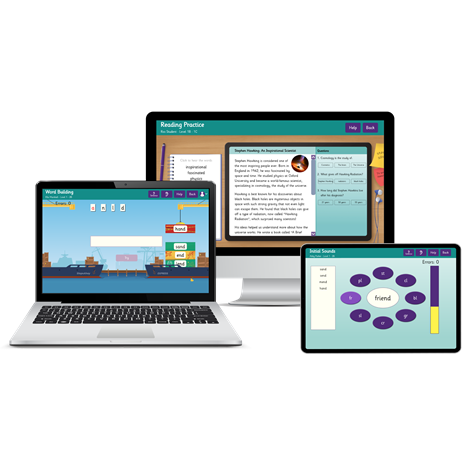
StepsWeb
Engaging, adaptive literacy practice for every learner, proven to boost core reading and spelling skills through a Structured Literacy approach.
 Updated Jan 2025
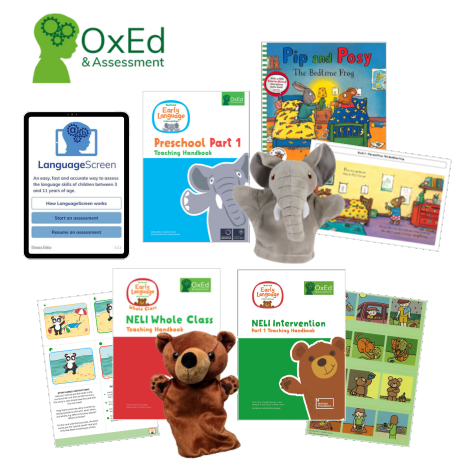
OxEd language assessment, intervention and enrichment
Effective, research-backed assessments, interventions and whole-class resources designed to improve oral language skills, tailored for the Australian and New Zealand curriculum.
 Updated May 2025
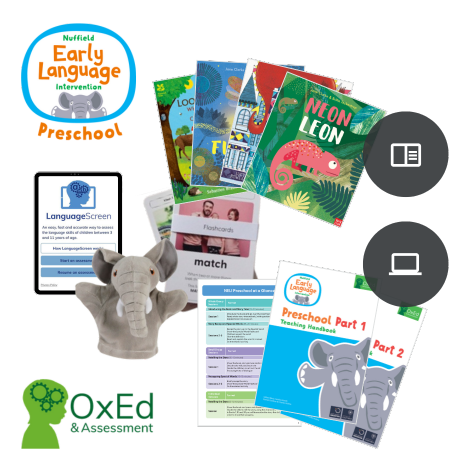
Build a language rich environment with NELI Preschool
Help children aged 3–4 build confidence and essential communication skills while having fun using this evidence-based oral language assessment, intervention and whole class enrichment resource.
Read next