Ch. 18 The Cardiovascular System: The Heart
Marieb - Human Anatomy & Physiology 7th Edition
Marieb, Hoehn7th EditionHuman Anatomy & PhysiologyISBN: 9780805359091Not the one you use?Change textbook
Chapter 17, Problem 21

You have been called upon to demonstrate the technique for listening to valve sounds.
Explain where you would position your stethoscope to auscultate.
(1) the aortic valve of a patient with severe aortic valve insufficiency and
(2) a stenotic mitral valve.
During which period(s) would you hear these abnormal valve sounds most clearly? (During atrial diastole, ventricular systole, ventricular diastole, or atrial systole?)
What cues would you use to differentiate between an insufficient and a stenotic valve?

Verified step by step guidance
1
Step 1: Identify the anatomical locations on the chest where the valve sounds are best auscultated. For the aortic valve, place the stethoscope at the right second intercostal space near the sternum. For the mitral valve, position the stethoscope at the apex of the heart, which is typically found at the left fifth intercostal space at the midclavicular line.
Step 2: Understand the timing of valve sounds in relation to the cardiac cycle. The aortic valve opens during ventricular systole, so abnormal sounds related to aortic valve insufficiency (regurgitation) are best heard during ventricular diastole when blood flows back into the left ventricle. The mitral valve opens during ventricular diastole, so sounds from a stenotic mitral valve are best heard during ventricular diastole as well, especially during the rapid filling phase.
Step 3: Differentiate between insufficiency and stenosis by the quality and timing of the murmur. An insufficient (regurgitant) valve causes blood to flow backward, producing a murmur during the phase when the valve should be closed (e.g., aortic insufficiency murmur during diastole). A stenotic valve causes turbulent flow during valve opening, producing a murmur during the phase when the valve should be open (e.g., mitral stenosis murmur during diastole).
Step 4: Use the cardiac cycle phases to pinpoint when to listen carefully. For aortic valve insufficiency, listen during ventricular diastole. For mitral valve stenosis, listen during ventricular diastole, particularly after the opening snap if present. Recognize that atrial systole can accentuate mitral stenosis murmurs due to increased flow across the narrowed valve.
Step 5: Summarize cues for differentiation: timing of murmur (systolic vs diastolic), location of maximal intensity (aortic area vs mitral area), and sound characteristics (blowing, high-pitched for insufficiency; rumbling, low-pitched for stenosis). These help distinguish between valve insufficiency and stenosis during auscultation.

Verified video answer for a similar problem:

This video solution was recommended by our tutors as helpful for the problem above.
Video duration:
1m
Was this helpful?

Key Concepts

Here are the essential concepts you must grasp in order to answer the question correctly.

Auscultation Sites for Heart Valves

Each heart valve is best heard at specific chest locations where blood flow turbulence is transmitted. The aortic valve is auscultated at the right second intercostal space near the sternum, while the mitral valve is best heard at the apex, around the fifth intercostal space at the midclavicular line. Proper positioning of the stethoscope is essential to accurately detect valve sounds and murmurs.
Recommended video:
Guided course
7:13
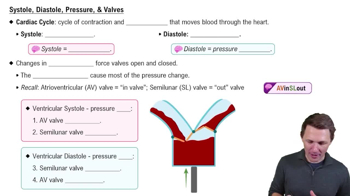
Systole, Diastole, Pressure, & Valves

Timing of Valve Sounds in the Cardiac Cycle

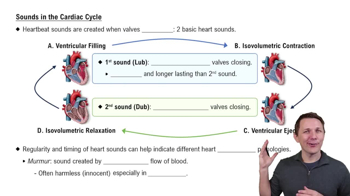
Valve sounds occur during specific phases of the cardiac cycle. The aortic valve opens during ventricular systole, so murmurs related to aortic insufficiency are heard during diastole when the valve should be closed. The mitral valve opens during ventricular diastole, so stenotic mitral valve murmurs are best heard during diastole. Understanding these timings helps identify when abnormal sounds occur.
Recommended video:
Guided course
7:54
Sounds in the Cardiac Cycle

Differentiating Valve Insufficiency and Stenosis by Murmur Characteristics

Valve insufficiency (regurgitation) causes backward blood flow, producing a murmur during valve closure phases, often described as a blowing sound. Stenosis involves narrowing, causing turbulent forward flow during valve opening, producing a harsh, crescendo-decrescendo murmur. Recognizing murmur timing, quality, and location helps distinguish between insufficiency and stenosis.
Recommended video:
Guided course
00:48
5 Characteristics of Epithelia