a. Estimate lim x→π/4 cos 2x / cos x − sin x by making a table of values of cos 2x / cos x − sin x for values of x approaching π/4. Round your estimate to four digits.
Ch. 2 - Limits
Briggs3rd EditionCalculus: Early TranscendentalsISBN: 9780136847243Not the one you use?Change textbook
Chapter 2, Problem 2.9a
Complete the following sentences in terms of a limit.
a. A function is continuous from the left at a if _____.
Verified step by step guidance1
Step 1: Understand the concept of continuity from the left. A function is continuous from the left at a point \( a \) if the left-hand limit of the function as \( x \) approaches \( a \) is equal to the function's value at \( a \).
Step 2: Express the left-hand limit mathematically. The left-hand limit of a function \( f(x) \) as \( x \) approaches \( a \) from the left is denoted as \( \lim_{{x \to a^-}} f(x) \).
Step 3: State the condition for left continuity. For the function \( f(x) \) to be continuous from the left at \( a \), the condition \( \lim_{{x \to a^-}} f(x) = f(a) \) must be satisfied.
Step 4: Consider the implications. This means that as \( x \) gets arbitrarily close to \( a \) from values less than \( a \), the function values \( f(x) \) should approach \( f(a) \).
Step 5: Summarize the sentence. A function is continuous from the left at \( a \) if \( \lim_{{x \to a^-}} f(x) = f(a) \).

Verified video answer for a similar problem:
This video solution was recommended by our tutors as helpful for the problem above.
Video duration:
1mWas this helpful?
Key Concepts
Here are the essential concepts you must grasp in order to answer the question correctly.
Limit of a Function
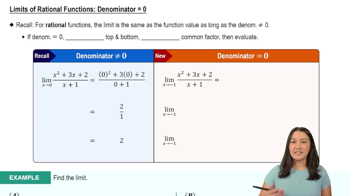
The limit of a function describes the value that the function approaches as the input approaches a certain point. It is a fundamental concept in calculus that helps in understanding the behavior of functions near specific points, especially when they are not defined at those points.
Recommended video:
Limits of Rational Functions: Denominator = 0
Continuity
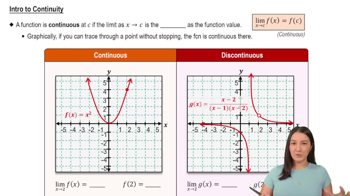
A function is continuous at a point if the limit of the function as it approaches that point equals the function's value at that point. This means there are no breaks, jumps, or holes in the graph of the function at that point, ensuring a smooth transition.
Recommended video:
Intro to Continuity
One-Sided Limits
One-sided limits refer to the behavior of a function as it approaches a specific point from one side only, either the left or the right. For a function to be continuous from the left at a point 'a', the left-hand limit must equal the function's value at 'a', indicating that the function approaches a specific value as the input approaches 'a' from the left.
Recommended video:
One-Sided Limits
Related Practice
Textbook Question
382
views
Textbook Question
The graph of ℎ in the figure has vertical asymptotes at x=−2 and x=3. Analyze the following limits. <IMAGE>
lim x→−2^− h(x)
397
views
Textbook Question
For the following position functions, make a table of average velocities similar to those in Exercises 19–20 and make a conjecture about the instantaneous velocity at the indicated time.
a. s(t)=−16t^2+80t+60 at t=3
427
views
Textbook Question
Determine the following limits.
a.
360
views
Textbook Question
Tangent lines with zero slope
a. Graph the function f(x)=x^2−4x+3.
402
views
Textbook Question
Graph the function f(x)=e^−x / x(x+2)^2 using a graphing utility. (Experiment with your choice of a graphing window.) Use your graph to determine the following limits.
a. lim x→−2^+ f(x)
354
views