Ch. 4 - Applications of Derivatives
Hass - Thomas' Calculus 15th Edition
Hass15th EditionThomas' CalculusISBN: 9780137616077Not the one you use?Change textbook
Chapter 4, Problem 4.2.7

Checking the Mean Value Theorem


Which of the functions in Exercises 7–12 satisfy the hypotheses of the Mean Value Theorem on the given interval, and which do not? Give reasons for your answers.


f(x) = x²ᐟ³, [−1, 8]

Verified step by step guidance
1
Step 1: Recall the Mean Value Theorem (MVT), which states that if a function f is continuous on the closed interval [a, b] and differentiable on the open interval (a, b), then there exists at least one c in (a, b) such that f'(c) = (f(b) - f(a)) / (b - a).
Step 2: Check the continuity of f(x) = x^(2/3) on the interval [-1, 8]. A function is continuous if it has no breaks, jumps, or holes in the interval. Since x^(2/3) is a real-valued function for all x, it is continuous on [-1, 8].
Step 3: Check the differentiability of f(x) = x^(2/3) on the open interval (-1, 8). A function is differentiable at a point if it has a defined derivative at that point. Calculate the derivative f'(x) = (2/3)x^(-1/3).
Step 4: Analyze the derivative f'(x) = (2/3)x^(-1/3) for differentiability. The derivative is undefined at x = 0 because it involves division by zero. Therefore, f(x) is not differentiable at x = 0, which lies within the interval (-1, 8).
Step 5: Conclude that since f(x) = x^(2/3) is not differentiable at x = 0, it does not satisfy the hypotheses of the Mean Value Theorem on the interval [-1, 8].

Verified video answer for a similar problem:

This video solution was recommended by our tutors as helpful for the problem above.
Video duration:
5m
Was this helpful?

Key Concepts

Here are the essential concepts you must grasp in order to answer the question correctly.

Mean Value Theorem

The Mean Value Theorem (MVT) states that for a function f that is continuous on a closed interval [a, b] and differentiable on the open interval (a, b), there exists at least one point c in (a, b) such that f'(c) equals the average rate of change over [a, b]. This theorem helps in understanding the behavior of functions and is crucial for determining if a function meets its conditions.
Recommended video:
06:11
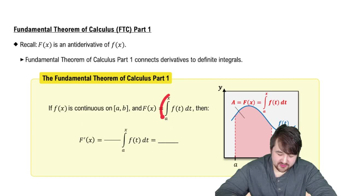
Fundamental Theorem of Calculus Part 1

Continuity

Continuity of a function on an interval means that the function has no breaks, jumps, or holes in that interval. For the Mean Value Theorem to apply, the function must be continuous on the closed interval [a, b]. In the context of the function f(x) = x²ᐟ³, we need to check if it is continuous on the interval [-1, 8].
Recommended video:
05:34
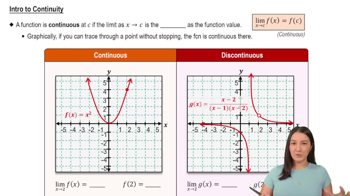
Intro to Continuity

Differentiability

Differentiability refers to the existence of a derivative at each point in an interval. For the Mean Value Theorem, the function must be differentiable on the open interval (a, b). For f(x) = x²ᐟ³, we must determine if the derivative exists for all x in (-1, 8), noting that differentiability implies continuity, but not vice versa.
Recommended video:
05:53
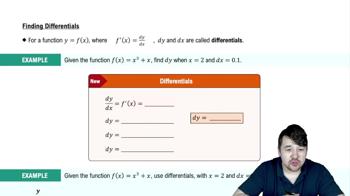
Finding Differentials