Ch. 7 - Logarithmic, Exponential Functions, and Hyperbolic Functions
Briggs - Calculus: Early Transcendentals 3rd Edition
Briggs3rd EditionCalculus: Early TranscendentalsISBN: 9780136847243Not the one you use?Change textbook
Chapter 7, Problem 7.2.19

15–20. Designing exponential growth functions Complete the following steps for the given situation.


a. Find the rate constant k and use it to devise an exponential growth function that fits the given data.
b. Answer the accompanying question.


Rising costs Between 2010 and 2016, the average rate of inflation was about 1.6%/yr. If a cart of groceries cost \$100 in 2010, what will it cost in 2025, assuming the rate of inflation remains constant at 1.6%?

Verified step by step guidance
1
Identify the general form of the exponential growth function, which is given by \(P(t) = P_0 e^{k t}\), where \(P_0\) is the initial amount, \(k\) is the growth rate constant, and \(t\) is the time in years.
Assign the known values: the initial price \(P_0 = 100\) dollars at time \(t = 0\) (year 2010), and the price at \(t = 6\) years (year 2016) reflects a 1.6% annual inflation rate. Since the inflation rate is 1.6%, the price grows by 1.6% each year, so \(P(6) = 100 imes (1 + 0.016)^6\).
Use the exponential growth formula to set up the equation for \(P(6)\): \$100 e^{6k} = 100 imes (1.016)^6\(. Simplify this to find \)e^{6k} = (1.016)^6$.
Take the natural logarithm of both sides to solve for \(k\): \(6k = \ln((1.016)^6)\), which simplifies to \(6k = 6 \ln(1.016)\). Then, solve for \(k\) by dividing both sides by 6, giving \(k = \ln(1.016)\).
With \(k\) found, write the exponential growth function as \(P(t) = 100 e^{k t}\). To find the cost in 2025, calculate \(P(15)\) since 2025 is 15 years after 2010, by substituting \(t = 15\) into the function.

Verified video answer for a similar problem:

This video solution was recommended by our tutors as helpful for the problem above.
Video duration:
2m
Was this helpful?

Key Concepts

Here are the essential concepts you must grasp in order to answer the question correctly.

Exponential Growth Function

An exponential growth function models quantities that increase at a rate proportional to their current value. It is generally expressed as P(t) = P_0 * e^(kt), where P_0 is the initial amount, k is the growth rate constant, and t is time. This function is essential for modeling inflation or population growth over time.
Recommended video:
09:29
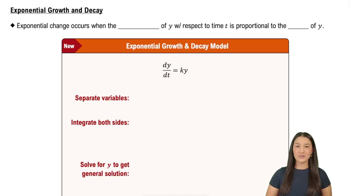
Exponential Growth & Decay

Rate Constant (k) in Exponential Growth

The rate constant k determines how quickly the quantity grows or decays in an exponential function. It can be found using the formula k = ln(1 + r), where r is the growth rate expressed as a decimal. Knowing k allows you to create the exact exponential model fitting the given data.
Recommended video:
09:29
Exponential Growth & Decay

Applying Exponential Growth to Inflation

Inflation causes prices to increase exponentially over time at a steady percentage rate. By using the exponential growth model with the inflation rate as k, you can predict future prices. For example, starting with a known price, you calculate its value at a future time by plugging into the exponential formula.
Recommended video:
09:29
Exponential Growth & Decay