Ch. 4 - Exponential and Logarithmic Functions
Blitzer - College Algebra 8th Edition
Blitzer8th EditionCollege AlgebraISBN: 9780136970514Not the one you use?Change textbook
Chapter 5, Problem 108

In Exercises 105–108, evaluate each expression without using a calculator. log (ln e)

Verified step by step guidance
1
Recognize the expression: \( \log(\ln e) \). Here, \( \ln e \) means the natural logarithm of \( e \), and \( \log \) typically refers to the logarithm base 10.
Evaluate the inner natural logarithm first: \( \ln e \). Recall that \( \ln e = 1 \) because the natural logarithm of \( e \) (Euler's number) is 1.
Substitute the value back into the expression: \( \log(1) \). Now the problem simplifies to finding \( \log(1) \).
Recall the property of logarithms: for any base \( b \), \( \log_b(1) = 0 \) because \( b^0 = 1 \).
Therefore, \( \log(1) = 0 \). So the value of the original expression \( \log(\ln e) \) is 0.

Verified video answer for a similar problem:

This video solution was recommended by our tutors as helpful for the problem above.
Video duration:
2m
Was this helpful?

Key Concepts

Here are the essential concepts you must grasp in order to answer the question correctly.

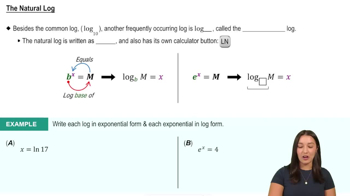
Natural Logarithm (ln)

The natural logarithm, denoted as ln, is the logarithm to the base e, where e ≈ 2.718. It answers the question: to what power must e be raised to get a certain number? For example, ln(e) = 1 because e¹ = e.
Recommended video:
2:51
The Natural Log

Logarithm Properties

Logarithms have properties that simplify expressions, such as log(a^b) = b log(a) and log(1) = 0. Understanding these properties helps evaluate nested logarithmic expressions without a calculator.
Recommended video:
5:36
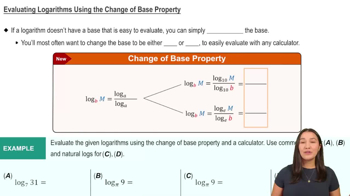
Change of Base Property

Relationship Between log and ln

The notation log often implies base 10, while ln is base e. Evaluating expressions like log(ln e) requires first finding ln e, then applying the base-10 logarithm to that result.
Recommended video:
2:51
The Natural Log