Ch. 3 - An Introduction to Organic Compounds:Nomenclature, Physical Properties, and Structure
Bruice - Organic Chemistry 8th Edition
Bruice8th EditionOrganic ChemistryISBN: 9780135213711Not the one you use?Change textbook
Chapter 4, Problem 40a

Draw all the staggered and eclipsed conformers that result from rotation about the C-2-C-3 bond of pentane.

Verified step by step guidance
1
Identify the structure of pentane and locate the C-2 and C-3 bond. Pentane is a straight-chain alkane with the molecular formula C5H12. The C-2 and C-3 bond is the second carbon-carbon single bond in the chain.
Understand the concept of conformers. Conformers are different spatial arrangements of a molecule that result from rotation about a single bond. For the C-2-C-3 bond, rotation will lead to staggered and eclipsed conformations.
Draw the Newman projection for the C-2-C-3 bond. In a Newman projection, the front carbon (C-2) is represented as a dot, and the back carbon (C-3) is represented as a circle. The substituents on each carbon are drawn as lines radiating from the dot and circle.
Systematically rotate the back carbon (C-3) relative to the front carbon (C-2) in 60° increments. For each 60° rotation, draw the resulting conformer. This will include three staggered conformers (where the substituents on the front and back carbons are as far apart as possible) and three eclipsed conformers (where the substituents on the front and back carbons overlap).
Label each conformer as either staggered or eclipsed, and note the relative energy of each conformer. Staggered conformers are generally lower in energy due to reduced torsional strain, while eclipsed conformers are higher in energy due to increased torsional strain.

Verified video answer for a similar problem:

This video solution was recommended by our tutors as helpful for the problem above.
Video duration:
2m
Was this helpful?

Key Concepts

Here are the essential concepts you must grasp in order to answer the question correctly.

Conformational Isomerism

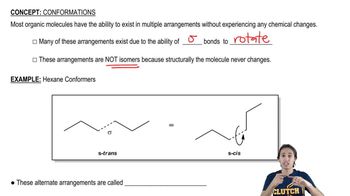
Conformational isomerism refers to the different spatial arrangements of atoms in a molecule that can be interconverted by rotation around single bonds. In the case of pentane, the rotation around the C-2-C-3 bond leads to various conformers, including staggered and eclipsed forms, which differ in their energy and stability.
Recommended video:
Guided course
03:29
Understanding what a conformer is.

Staggered and Eclipsed Conformers

Staggered conformers occur when the substituents on adjacent carbon atoms are positioned as far apart as possible, minimizing steric strain and maximizing stability. In contrast, eclipsed conformers have substituents aligned with each other, leading to increased steric hindrance and higher energy states. Understanding these conformers is crucial for analyzing the stability of pentane's rotational conformations.
Recommended video:
Guided course
03:29
Understanding what a conformer is.

Potential Energy Diagram

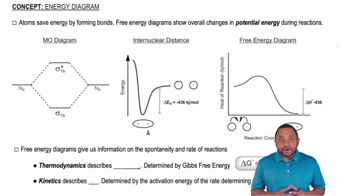
A potential energy diagram illustrates the energy changes associated with the rotation around a bond, showing the relative stability of staggered versus eclipsed conformers. As the molecule rotates, energy peaks correspond to eclipsed conformers (higher energy) and troughs to staggered conformers (lower energy). This concept helps predict the preferred conformations of pentane based on energy considerations.
Recommended video:
Guided course
06:07
Introduction to free energy diagrams.