Ch. 2 - Acids and Bases; Functional Groups
Wade - Organic Chemistry 9th Edition
Wade9th EditionOrganic ChemistryISBN: 9780135213728Not the one you use?Change textbook
Chapter 2, Problem 41b,c,d

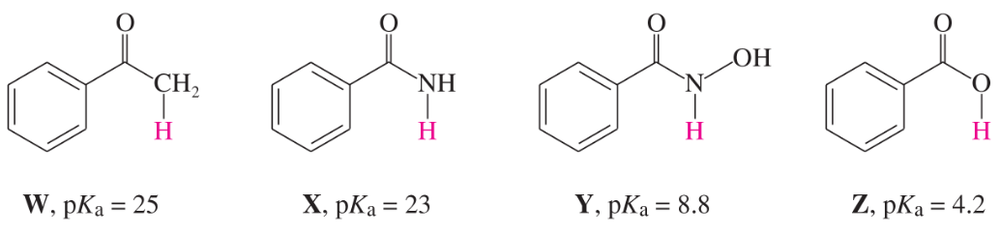
The following compounds are listed in increasing order of acidity. In each case, the most acidic proton is shown in red.

b. Explain why X is a stronger acid than W.
c. Explain why Y is a stronger acid than X.
d. Explain why Z is a stronger acid than Y.

Verified step by step guidance
1
Identify the structural differences between compounds W and X. Compound W has a methylene group (CH2) adjacent to the carbonyl, while compound X has an amide group (NH).
Consider the effect of the amide group in X. The nitrogen in the amide can participate in resonance with the carbonyl group, stabilizing the conjugate base more effectively than the methylene group in W.
Examine the structural difference between compounds X and Y. Compound Y has an additional hydroxyl group (OH) attached to the nitrogen, forming a hydroxamic acid.
Analyze the effect of the hydroxyl group in Y. The presence of the OH group increases the acidity by allowing additional resonance stabilization of the conjugate base, as well as potential hydrogen bonding interactions.
Compare compounds Y and Z. Compound Z is a carboxylic acid, which is generally more acidic due to the high resonance stabilization of its conjugate base (carboxylate ion) and the electronegative oxygen atoms that stabilize the negative charge.

Verified video answer for a similar problem:

This video solution was recommended by our tutors as helpful for the problem above.
Video duration:
3m
Was this helpful?

Key Concepts

Here are the essential concepts you must grasp in order to answer the question correctly.

Acidity and pKa

Acidity in organic chemistry is often measured using the pKa value, which indicates the strength of an acid. A lower pKa value corresponds to a stronger acid, meaning it more readily donates protons (H+). Understanding the relationship between pKa and acidity is crucial for comparing the acidity of different compounds.
Recommended video:
07:45
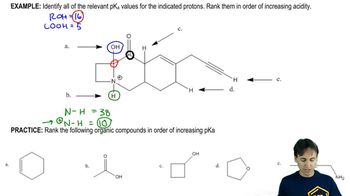
Identifying pKa values

Resonance Stabilization

Resonance stabilization occurs when a molecule can distribute its electron density across multiple structures, leading to increased stability. In the context of acidity, if the conjugate base formed after deprotonation can be stabilized by resonance, the original acid will be stronger. This concept helps explain why certain compounds have lower pKa values.
Recommended video:
03:43
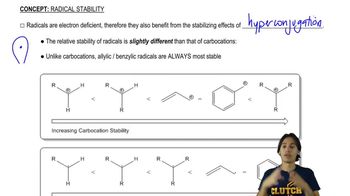
The radical stability trend.

Inductive Effect

The inductive effect refers to the electron-withdrawing or electron-donating effects of substituents on a molecule. Electronegative atoms or groups can stabilize the negative charge on a conjugate base through inductive withdrawal, enhancing acidity. This effect is important in comparing the acidity of compounds with different substituents.
Recommended video:
01:47
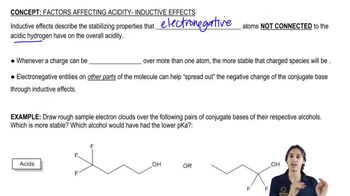
Understanding the Inductive Effect.