Ch. 22 - Catalysis in Organic Reactions and in Enzymatic Reactions
Bruice - Organic Chemistry 8th Edition
Bruice8th EditionOrganic ChemistryISBN: 9780135213711Not the one you use?Change textbook
Chapter 22, Problem 2(4)

Compare each of the mechanisms listed here with the mechanism for each of the two parts of the acid-catalyzed hydrolysis of an ester, indicating a. similarities. b. differences.
4. acid-catalyzed hydrolysis of an amide

Verified step by step guidance
1
Step 1: Understand the acid-catalyzed hydrolysis of an ester. This reaction involves two main parts: (1) protonation of the ester carbonyl group to make it more electrophilic, followed by nucleophilic attack by water, and (2) subsequent steps leading to the formation of a carboxylic acid and an alcohol.
Step 2: Review the acid-catalyzed hydrolysis of an amide (Section 15.12). This reaction also involves protonation of the carbonyl group to increase its electrophilicity, followed by nucleophilic attack by water. The reaction proceeds through a tetrahedral intermediate and ultimately forms a carboxylic acid and an amine or ammonia.
Step 3: Compare the similarities between the two mechanisms. Both reactions are acid-catalyzed and involve protonation of the carbonyl group to enhance electrophilicity. Both proceed through a tetrahedral intermediate and result in the cleavage of the C-N or C-O bond to form a carboxylic acid.
Step 4: Identify the differences between the two mechanisms. In ester hydrolysis, the leaving group is an alcohol, whereas in amide hydrolysis, the leaving group is an amine or ammonia. Additionally, amides are generally less reactive than esters due to resonance stabilization of the amide bond, so harsher conditions (e.g., higher temperature or stronger acid) may be required for amide hydrolysis.
Step 5: Summarize the key points. Both mechanisms share a similar overall pathway but differ in the nature of the leaving group and the reactivity of the starting material. These differences are due to the electronic properties of esters and amides.

Verified video answer for a similar problem:

This video solution was recommended by our tutors as helpful for the problem above.
Video duration:
3m

Key Concepts

Here are the essential concepts you must grasp in order to answer the question correctly.

Acid-Catalyzed Hydrolysis

Acid-catalyzed hydrolysis is a reaction where an ester or amide is converted into its corresponding acid and alcohol or amine in the presence of an acid catalyst. The acid donates protons to facilitate the breaking of the carbon-oxygen or carbon-nitrogen bond, enhancing the nucleophilicity of water. This mechanism typically involves the formation of a tetrahedral intermediate, which is a key feature in both ester and amide hydrolysis.
Recommended video:
03:09
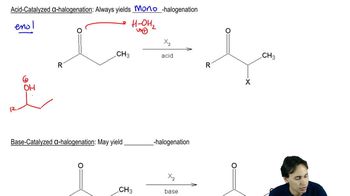
Acid Catalyzed

Mechanism Comparison

Comparing mechanisms involves analyzing the steps and intermediates involved in each reaction pathway. In the case of acid-catalyzed hydrolysis of esters and amides, one must consider the role of the nucleophile (water) and the nature of the leaving group. While both mechanisms share similarities in protonation and nucleophilic attack, differences arise in the stability of intermediates and the nature of the products formed.
Recommended video:
03:32
How do we predict if the mechanism is SN1 or SN2?

Tetrahedral Intermediates

Tetrahedral intermediates are crucial in the hydrolysis of esters and amides, formed when the nucleophile attacks the carbonyl carbon. In ester hydrolysis, this intermediate leads to the formation of an alcohol and a carboxylic acid, while in amide hydrolysis, it results in an amine and a carboxylic acid. Understanding the formation and stability of these intermediates helps in distinguishing the mechanisms and predicting the reaction outcomes.
Recommended video:
04:31
Stability of Conjugated Intermediates