
Textbook Question
Match the bone markings listed on the right with their function listed on the left.
1. Attachment site for muscle or ligament
2. Forms a joint surface
3. Passageway for vessels or nerves
f. Tuberosity
542
views

 Verified step by step guidance
 8:20
8:20
 4:42 8:20
Match the bone markings listed on the right with their function listed on the left.
1. Attachment site for muscle or ligament
2. Forms a joint surface
3. Passageway for vessels or nerves
f. Tuberosity
Match the bone markings listed on the right with their function listed on the left.
1. Attachment site for muscle or ligament
2. Forms a joint surface
3. Passageway for vessels or nerves
e. Facet
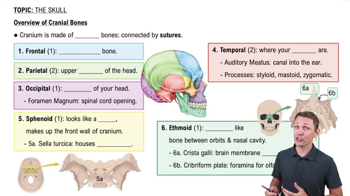
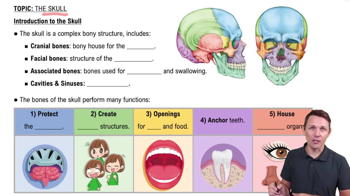
What facial bone forms the chin? The cheekbone? The upper jaw? The bony eyebrow ridges?
Name two ways in which the fetal skull differs from the adult skull. A certain short-day plant flowers only when days are less than 12 hours long. Which of the following would cause it to flower?
a. A 9-hour night and 15-hour day with 1 minute of darkness after 7 hours
b. An 8-hour day and 16-hour night with a flash of white light after 8 hours
c. A 13-hour night and 11-hour day with 1 minute of darkness after 6 hours
d. A 12-hour day and 12-hour night with a flash of red light after 6 hours
What is yellow marrow? How do spongy and compact bone look different?
Name the bones of the shoulder girdle.