Ch. 5 The Skeletal System
Marieb - Essentials of Human Anatomy & Physiology 13th Edition
Marieb13th EditionEssentials of Human Anatomy & PhysiologyISBN: 9780135624340Not the one you use?Change textbook
Chapter 5, Problem 11f

Match the types of joints to the descriptions that apply to them.
a. Fibrous joints
b. Cartilaginous joints
c. Synovial joints
6. All are diarthroses

Verified step by step guidance
1
Understand the term 'diarthroses': Diarthroses are joints that are freely movable. This is a key characteristic to match with the correct type of joint.
Review the characteristics of fibrous joints: Fibrous joints are typically immovable or only slightly movable, such as sutures in the skull. They are not diarthroses.
Review the characteristics of cartilaginous joints: Cartilaginous joints allow limited movement, such as the intervertebral discs or the pubic symphysis. They are not diarthroses.
Review the characteristics of synovial joints: Synovial joints are freely movable and include structures like the knee, shoulder, and hip joints. These are diarthroses.
Match the description 'All are diarthroses' to synovial joints, as they are the only type of joint that fits this description.

Verified video answer for a similar problem:

This video solution was recommended by our tutors as helpful for the problem above.
Video duration:
2m
Was this helpful?

Key Concepts

Here are the essential concepts you must grasp in order to answer the question correctly.

Types of Joints

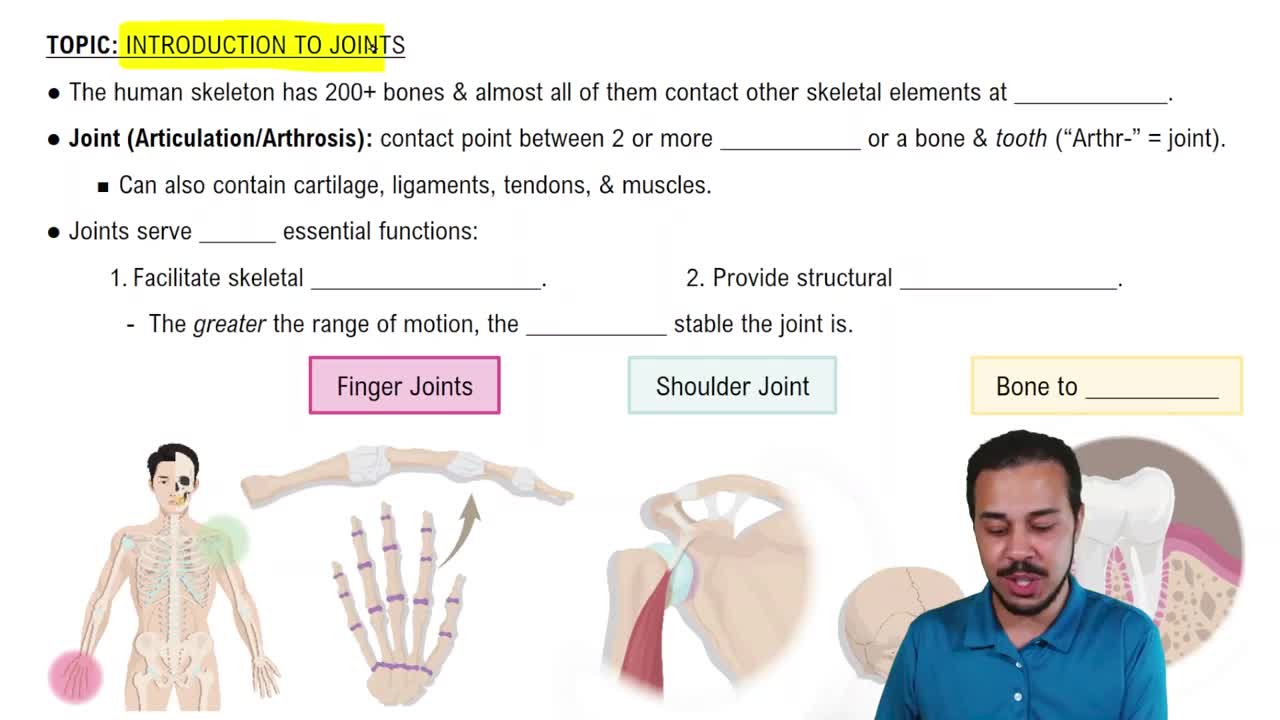
Joints are classified into three main types: fibrous, cartilaginous, and synovial. Fibrous joints are connected by dense connective tissue and allow little to no movement. Cartilaginous joints are connected by cartilage and permit limited movement. Synovial joints, the most mobile type, are characterized by a fluid-filled joint cavity.
Recommended video:
05:39
Introduction to Joints

Diarthroses

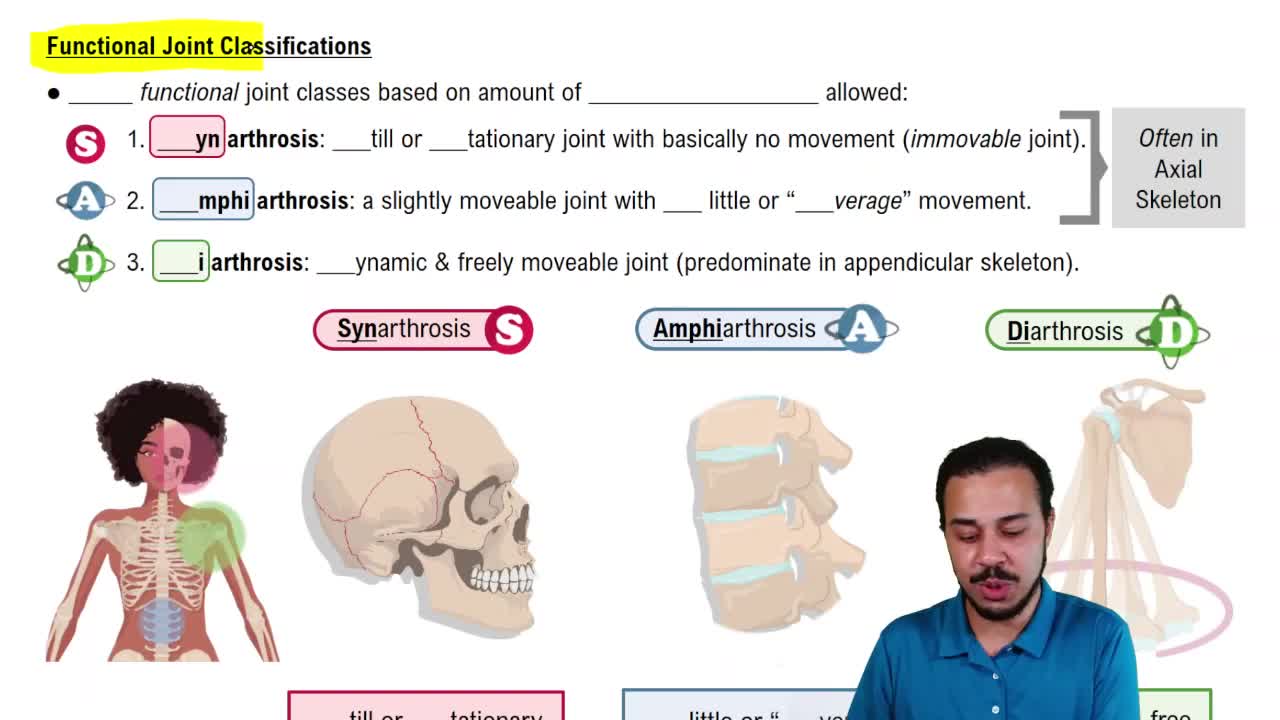
Diarthroses are a category of joints that are freely movable, primarily referring to synovial joints. These joints allow a wide range of motion and are essential for various physical activities. Examples include the knee, elbow, and shoulder joints, which facilitate complex movements.
Recommended video:
08:43
Functional Joint Classifications

Joint Functionality

Understanding joint functionality is crucial for distinguishing between the types of joints. Fibrous and cartilaginous joints are generally immovable or slightly movable, while synovial joints are designed for extensive movement. This functionality impacts how joints are used in daily activities and physical exercise.
Recommended video:
08:43
Functional Joint Classifications