Ch. 18 The Cardiovascular System: The Heart
Chapter 17, Problem 11

Draw a normal ECG pattern. Label and explain the significance of its deflection waves.

Verified step by step guidance
1
Step 1: Begin by sketching a horizontal baseline to represent the isoelectric line, which indicates no net electrical activity in the heart at that moment.
Step 2: Draw the P wave as a small upward deflection from the baseline. This wave represents atrial depolarization, which is the electrical activation causing the atria to contract.
Step 3: Next, draw the QRS complex, which consists of three parts: a small downward deflection (Q wave), a large upward spike (R wave), and a downward deflection following the spike (S wave). This complex represents ventricular depolarization, the electrical event that triggers ventricular contraction.
Step 4: After the QRS complex, draw the T wave as a moderate upward deflection. The T wave represents ventricular repolarization, which is the process of the ventricles recovering electrically and preparing for the next contraction.
Step 5: Label each wave (P, Q, R, S, T) on your drawing and briefly note their significance: P wave for atrial depolarization, QRS complex for ventricular depolarization, and T wave for ventricular repolarization. This helps in understanding the electrical activity and timing of heart muscle contractions.

Verified video answer for a similar problem:

This video solution was recommended by our tutors as helpful for the problem above.
Video duration:
3m
Was this helpful?

Key Concepts

Here are the essential concepts you must grasp in order to answer the question correctly.

Normal ECG Pattern

A normal ECG (electrocardiogram) pattern represents the electrical activity of the heart during a cardiac cycle. It typically includes the P wave, QRS complex, and T wave, each corresponding to specific phases of heart muscle depolarization and repolarization.
Recommended video:
Guided course
4:36
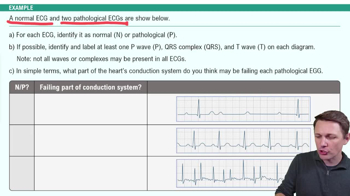
Electrocardiogram (ECG) Example 2

Deflection Waves in ECG

Deflection waves are the upward or downward movements on the ECG tracing that reflect electrical changes in the heart. The P wave indicates atrial depolarization, the QRS complex shows ventricular depolarization, and the T wave represents ventricular repolarization.
Recommended video:
Guided course
4:36
Electrocardiogram (ECG) Example 2

Significance of ECG Waves

Each wave in the ECG provides critical information about heart function. For example, abnormalities in the P wave can indicate atrial issues, changes in the QRS complex may suggest ventricular problems, and T wave alterations can reflect repolarization abnormalities or ischemia.
Recommended video:
Guided course
4:36
Electrocardiogram (ECG) Example 2