Pearson+ LogoPearson+ Logo
Ch. 15 Tracing Evolutionary History
Taylor - Campbell Biology: Concepts & Connections 10th Edition
Taylor, Simon, Dickey, Hogan10th EditionCampbell Biology: Concepts & ConnectionsISBN: 9780136538783Not the one you use?Change textbook
Chapter 15, Problem 13

How can the Darwinian concept of descent with modification explain the evolution of such complex structures as an eye?

Verified step by step guidance
1
Understand the concept of 'descent with modification': This principle suggests that all organisms share a common ancestor, and over generations, small genetic changes accumulate, leading to the development of new traits and structures.
Recognize that complex structures like the eye did not appear fully formed: Instead, they evolved gradually through a series of intermediate stages, each providing a functional advantage to the organism.
Consider the role of natural selection: Variations in light-sensitive cells or structures would have been advantageous for survival and reproduction, leading to the gradual refinement of these features over time.
Study examples of simpler eye structures in existing organisms: For instance, some organisms have light-sensitive patches, others have cup-shaped eyes, and others have more complex lens-based eyes. These examples illustrate the potential evolutionary pathway of the eye.
Acknowledge the cumulative nature of evolution: Small, incremental changes that improve an organism's ability to detect light or focus images would be preserved and built upon over millions of years, resulting in the complex eyes seen in many species today.

Verified video answer for a similar problem:

This video solution was recommended by our tutors as helpful for the problem above.
Video duration:
29s
Was this helpful?

Key Concepts

Here are the essential concepts you must grasp in order to answer the question correctly.

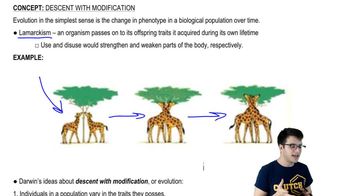
Descent with Modification

Descent with modification is a fundamental principle of Darwinian evolution, which posits that species evolve over time through gradual changes in their traits. This process occurs as organisms pass on their genetic material to their offspring, leading to variations that can be advantageous for survival. Over generations, these modifications accumulate, resulting in the diversity of life forms we observe today.
Recommended video:
Guided course
04:52
Descent With Modification

Natural Selection

Natural selection is the mechanism by which certain traits become more common in a population due to their advantageous effects on survival and reproduction. Organisms with traits that better suit their environment are more likely to survive and reproduce, passing those traits to the next generation. This process can lead to the development of complex structures, such as the eye, as beneficial adaptations are preserved over time.
Recommended video:
04:43
Natural Selection

Complex Structures in Evolution

The evolution of complex structures, like the eye, can be explained through a series of incremental adaptations that enhance functionality. Each stage of development may provide some advantage, even if it is not fully formed. For example, simple light-sensitive cells could offer a survival benefit, leading to further modifications that eventually result in a sophisticated organ capable of vision.
Recommended video:
06:15
Origin of Complex Traits