Pearson+ LogoPearson+ Logo
Ch. 1 - Can Science Cure the Common Cold?
Belk, Maier - Biology: Science for Life 6th Edition
Belk, Maier6th EditionBiology: Science for LifeISBN: 9780135214084Not the one you use?Change textbook
Chapter 1, Problem 3

A scientific hypothesis is ________.
a. An opinion
b. A proposed explanation for an observation
c. A fact
d. Easily proved true
e. An idea proposed by a scientist

Verified step by step guidance
1
Understand the definition of a scientific hypothesis: A scientific hypothesis is a testable and falsifiable proposed explanation for a specific observation or phenomenon.
Eliminate options that do not align with the definition of a hypothesis. For example, a hypothesis is not an opinion (option a) because opinions are subjective and not necessarily testable.
Consider whether a hypothesis is a fact (option c). A fact is a confirmed observation, while a hypothesis is a proposed explanation that requires testing.
Evaluate whether a hypothesis is 'easily proved true' (option d). Hypotheses are not easily proved true; they are tested through experiments and can be supported or refuted based on evidence.
Analyze whether a hypothesis is simply 'an idea proposed by a scientist' (option e). While scientists propose hypotheses, the key characteristic is that it must be testable and falsifiable, making option b the most accurate choice.

Verified video answer for a similar problem:

This video solution was recommended by our tutors as helpful for the problem above.
Video duration:
40s
Was this helpful?

Key Concepts

Here are the essential concepts you must grasp in order to answer the question correctly.

Scientific Hypothesis

A scientific hypothesis is a testable statement that provides a proposed explanation for a specific observation or phenomenon. It is formulated based on existing knowledge and observations, and it serves as a starting point for further investigation. Unlike opinions, hypotheses must be based on empirical evidence and can be supported or refuted through experimentation.
Recommended video:
Guided course
06:29
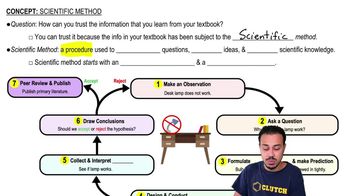
Scientific Method

Testability

Testability refers to the ability of a hypothesis to be tested through experiments or observations. A hypothesis must be structured in a way that allows for empirical validation, meaning it can be supported or disproven by data. This characteristic distinguishes scientific hypotheses from mere opinions or untestable ideas.
Recommended video:
Guided course
08:22
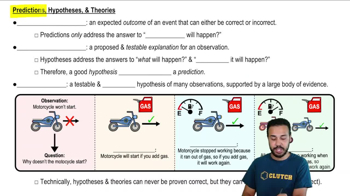
Predictions, Hypotheses, & Theories

Empirical Evidence

Empirical evidence is information acquired by observation or experimentation that can be used to support or refute a hypothesis. It is crucial in the scientific method, as it provides the basis for validating claims and theories. The reliance on empirical evidence ensures that scientific conclusions are grounded in observable reality rather than speculation.
Recommended video:
02:27
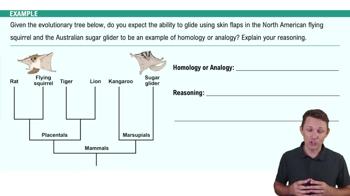
Evidence of Evolution Example 1
Related Practice
Textbook Question
Add labels to the figure that follows, which illustrates the characteristics of research participants in control versus experimental groups.

1099
views
Textbook Question

Which of the following is an example of inductive reasoning?

a. All cows eat grass.

b. My cow eats grass and my neighbor's cow eats grass; therefore, all cows probably eat grass.

c. If all cows eat grass, when I examine a random sample of all the cows in Minnesota, I will find that all of them eat grass.

d. Cows may or may not eat grass, depending on the type of farm where they live.

3216
views
Textbook Question

How is a scientific theory different from a scientific hypothesis?

a. It is based on weaker evidence

b. It has not been proved true

c. It is not falsifiable

d. It can explain a large number of observations

e. It must be proposed by a professional scientist

2244
views
Textbook Question

One hypothesis states that eating chicken noodle soup is an effective treatment for colds. Which of the following results does this hypothesis predict?

a. People who eat chicken noodle soup have shorter colds than do people who do not eat chicken noodle soup.

b. People who do not eat chicken noodle soup experience unusually long and severe colds.

c. Cold viruses cannot live in chicken noodle soup.

d. People who eat chicken noodle soup feel healthier than do people who do not eat chicken noodle soup.

e. Consuming chicken noodle soup causes people to sneeze.

1046
views
Textbook Question

If I perform a hypothesis test in which I demonstrate that the prediction I made in question 5 is true, I have ________.

a. Proved the hypothesis

b. Supported the hypothesis

c. Not falsified the hypothesis

d. B and C are correct

e. A, B, and C are correct

1623
views