Pearson+ LogoPearson+ Logo
Ch. 1 - Can Science Cure the Common Cold?
Belk, Maier - Biology: Science for Life 6th Edition
Belk, Maier6th EditionBiology: Science for LifeISBN: 9780135214084Not the one you use?Change textbook
Chapter 1, Problem 4

How is a scientific theory different from a scientific hypothesis?
a. It is based on weaker evidence
b. It has not been proved true
c. It is not falsifiable
d. It can explain a large number of observations
e. It must be proposed by a professional scientist

Verified step by step guidance
1
Understand the definitions: A scientific hypothesis is a testable and falsifiable statement that serves as a starting point for experimentation. A scientific theory, on the other hand, is a well-substantiated explanation of some aspect of the natural world that is based on a body of evidence and has stood the test of time.
Recognize the scope: A scientific hypothesis typically addresses a specific question or observation, while a scientific theory explains a broader range of phenomena and integrates multiple hypotheses and observations.
Evaluate the evidence: A scientific theory is supported by extensive and reproducible evidence gathered from multiple experiments and observations, whereas a hypothesis is an initial idea that requires testing and validation.
Consider falsifiability: Both scientific hypotheses and theories must be falsifiable, meaning they can be tested and potentially disproven. This is a fundamental principle of science.
Analyze the options: Based on the definitions and characteristics, identify the correct answer. The correct choice should reflect the broader explanatory power and evidence-based nature of a scientific theory compared to a hypothesis.

Verified video answer for a similar problem:

This video solution was recommended by our tutors as helpful for the problem above.
Video duration:
1m
Was this helpful?

Key Concepts

Here are the essential concepts you must grasp in order to answer the question correctly.

Scientific Theory

A scientific theory is a well-substantiated explanation of some aspect of the natural world that is based on a body of evidence and has withstood rigorous testing and scrutiny. It integrates and generalizes many hypotheses and observations, providing a comprehensive framework for understanding phenomena. Unlike a hypothesis, which is a tentative explanation, a theory is widely accepted within the scientific community due to its strong empirical support.
Recommended video:
Guided course
06:29
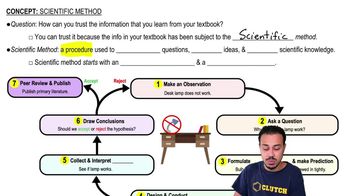
Scientific Method

Scientific Hypothesis

A scientific hypothesis is a proposed explanation for a phenomenon that can be tested through experimentation and observation. It is typically narrower in scope than a theory and serves as a starting point for further investigation. A hypothesis must be falsifiable, meaning it can be proven wrong through evidence, which distinguishes it from a theory that has already been validated by extensive research.
Recommended video:
Guided course
06:29
Scientific Method

Falsifiability

Falsifiability is a key principle in the philosophy of science that asserts a statement or hypothesis must be able to be proven false to be considered scientific. This means that there should be a possible observation or experiment that could contradict the hypothesis. Falsifiability is crucial for distinguishing scientific claims from non-scientific ones, as it allows for the testing and potential refutation of ideas.
Recommended video:
Guided course
08:22
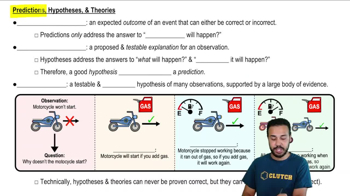
Predictions, Hypotheses, & Theories
Related Practice
Textbook Question
Add labels to the figure that follows, which illustrates the characteristics of research participants in control versus experimental groups.

1099
views
Textbook Question

Which of the following is an example of inductive reasoning?

a. All cows eat grass.

b. My cow eats grass and my neighbor's cow eats grass; therefore, all cows probably eat grass.

c. If all cows eat grass, when I examine a random sample of all the cows in Minnesota, I will find that all of them eat grass.

d. Cows may or may not eat grass, depending on the type of farm where they live.

3216
views
Textbook Question

A scientific hypothesis is ________.

a. An opinion

b. A proposed explanation for an observation

c. A fact

d. Easily proved true

e. An idea proposed by a scientist

1794
views
Textbook Question

One hypothesis states that eating chicken noodle soup is an effective treatment for colds. Which of the following results does this hypothesis predict?

a. People who eat chicken noodle soup have shorter colds than do people who do not eat chicken noodle soup.

b. People who do not eat chicken noodle soup experience unusually long and severe colds.

c. Cold viruses cannot live in chicken noodle soup.

d. People who eat chicken noodle soup feel healthier than do people who do not eat chicken noodle soup.

e. Consuming chicken noodle soup causes people to sneeze.

1046
views
Textbook Question

If I perform a hypothesis test in which I demonstrate that the prediction I made in question 5 is true, I have ________.

a. Proved the hypothesis

b. Supported the hypothesis

c. Not falsified the hypothesis

d. B and C are correct

e. A, B, and C are correct

1623
views
Textbook Question

Control subjects in an experiment _________.

a. Should be similar in most ways to the experimental subjects.

b. Should not know whether they are in the control or experimental group.

c. Should have essentially the same interactions with the researchers as the experimental subjects.

d. Help eliminate alternative hypotheses that could explain experimental results.

e. All of the above.

1632
views