Pearson+ LogoPearson+ Logo
Ch. 12 - An Evolving Enemy
Belk, Maier - Biology: Science for Life 6th Edition
Belk, Maier6th EditionBiology: Science for LifeISBN: 9780135214084Not the one you use?Change textbook
Chapter 12, Problem 10

Antibiotic resistance is becoming common among organisms that cause a variety of human diseases. All of the following strategies help reduce the risk of antibiotic resistance evolving in a susceptible bacterial population except:
a. Using antibiotics only when appropriate, for bacterial infections that are not clearing up naturally
b. Using the drugs as directed, taking all the antibiotic over the course of days prescribed
c. Using more than one antibiotic at a time for difficult-to-treat organisms
d. Preventing natural selection by reducing the amount of evolution the organisms can perform
e. Reducing the use of antibiotics in non–health-care settings, such as agriculture

Verified step by step guidance
1
Step 1: Understand the context of the problem. Antibiotic resistance occurs when bacteria evolve mechanisms to survive the effects of antibiotics. This is a result of natural selection, where resistant bacteria survive and reproduce, passing on their resistance genes.
Step 2: Analyze the strategies listed in the problem. The goal is to identify which strategy does NOT help reduce the risk of antibiotic resistance. Each strategy should be evaluated based on its ability to limit the evolution or spread of resistant bacteria.
Step 3: Evaluate option (a): Using antibiotics only when appropriate. This strategy helps reduce resistance by minimizing unnecessary exposure of bacteria to antibiotics, which could otherwise select for resistant strains.
Step 4: Evaluate option (d): Preventing natural selection by reducing the amount of evolution the organisms can perform. This statement is scientifically inaccurate because natural selection is a fundamental biological process that cannot be 'prevented.' This option does not align with effective strategies to combat antibiotic resistance.
Step 5: Conclude that the correct answer is the option that does not contribute to reducing antibiotic resistance. Based on the analysis, option (d) is the strategy that does not help reduce the risk of antibiotic resistance evolving in a bacterial population.

Verified video answer for a similar problem:

This video solution was recommended by our tutors as helpful for the problem above.
Video duration:
3m
Was this helpful?

Key Concepts

Here are the essential concepts you must grasp in order to answer the question correctly.

Antibiotic Resistance

Antibiotic resistance occurs when bacteria evolve mechanisms to withstand the effects of drugs that once killed them or inhibited their growth. This resistance can arise through genetic mutations or the acquisition of resistance genes from other bacteria. As a result, infections become harder to treat, leading to increased medical costs, prolonged hospital stays, and a higher risk of mortality.
Recommended video:
04:25
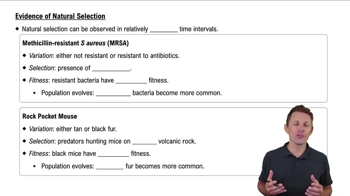
Evidence of Natural Selection

Natural Selection

Natural selection is a fundamental mechanism of evolution where organisms better adapted to their environment tend to survive and reproduce more successfully. In the context of antibiotic resistance, the overuse or misuse of antibiotics creates selective pressure, allowing resistant bacteria to thrive while susceptible ones are eliminated. This process accelerates the spread of resistance within bacterial populations.
Recommended video:
04:43
Natural Selection

Antibiotic Stewardship

Antibiotic stewardship refers to a set of strategies aimed at optimizing the use of antibiotics to combat resistance. This includes using antibiotics only when necessary, adhering to prescribed dosages, and reducing unnecessary prescriptions in both healthcare and agricultural settings. Effective stewardship helps preserve the efficacy of existing antibiotics and minimizes the development of resistant strains.
Recommended video:
04:25
Evidence of Natural Selection