Pearson+ LogoPearson+ Logo
Ch. 14 - The Greatest Species on Earth?
Belk, Maier - Biology: Science for Life 6th Edition
Belk, Maier6th EditionBiology: Science for LifeISBN: 9780135214084Not the one you use?Change textbook
Chapter 14, Problem 1

How many different species have been identified by science?
How many are estimated to exist?

Verified step by step guidance
1
Understand the context of the question: The problem is asking about the number of species identified by science and the estimated total number of species that exist. This involves concepts in biodiversity and taxonomy.
Step 1: Explain the term 'identified species': These are species that have been formally described and named by scientists, following the rules of taxonomy. This includes organisms across all domains of life, such as animals, plants, fungi, and microorganisms.
Step 2: Discuss the estimated number of species: Scientists use various methods, such as sampling and extrapolation, to estimate the total number of species on Earth. This includes species that have not yet been discovered or described.
Step 3: Highlight the disparity between identified and estimated species: While millions of species have been identified, the estimated number of species is much higher, indicating that a significant portion of Earth's biodiversity remains unexplored.
Step 4: Provide examples of why many species remain unidentified: Factors include inaccessible habitats (e.g., deep oceans, dense rainforests), microscopic organisms, and the rapid rate of extinction before discovery.

Verified video answer for a similar problem:

This video solution was recommended by our tutors as helpful for the problem above.
Video duration:
1m
Was this helpful?

Key Concepts

Here are the essential concepts you must grasp in order to answer the question correctly.

Biodiversity

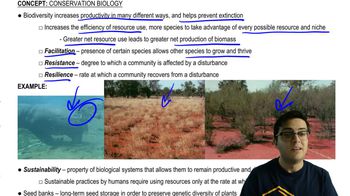
Biodiversity refers to the variety of life forms on Earth, encompassing the diversity of species, ecosystems, and genetic variations within species. It is crucial for ecosystem stability and resilience, providing essential services such as pollination, nutrient cycling, and climate regulation. Understanding biodiversity helps scientists assess the health of ecosystems and the impact of human activities on the environment.
Recommended video:
Guided course
05:06
Biodiversity and Sustainability

Species Identification

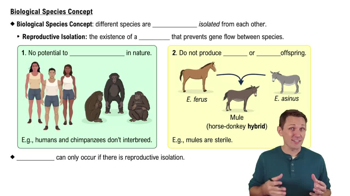
Species identification is the process of recognizing and classifying organisms based on their characteristics and genetic makeup. Scientists use various methods, including morphological analysis and genetic sequencing, to identify and categorize species. Accurate identification is essential for understanding biodiversity and monitoring changes in species populations over time.
Recommended video:
03:24
Biological Species Concept

Estimates of Species Richness

Estimates of species richness refer to the predicted number of species that exist in a particular area or globally, based on scientific research and statistical models. While approximately 1.5 million species have been formally described, estimates suggest that the total number could range from 5 to 30 million species, highlighting the vast unknown diversity on Earth. These estimates are important for conservation efforts and understanding ecological dynamics.
Recommended video:
03:24
Biological Species Concept