Pearson+ LogoPearson+ Logo
Ch. 14 - The Greatest Species on Earth?
Belk, Maier - Biology: Science for Life 6th Edition
Belk, Maier6th EditionBiology: Science for LifeISBN: 9780135214084Not the one you use?Change textbook
Chapter 14, Problem 2

Add labels to the figure that follows, which illustrates the endosymbiotic hypothesis.
<IMAGE>

Verified step by step guidance
1
Examine the figure carefully to identify the key components that represent the endosymbiotic hypothesis, such as mitochondria, chloroplasts, and the host cell.
Label the mitochondria in the figure, noting that they are believed to have originated from aerobic bacteria engulfed by an ancestral eukaryotic cell.
Label the chloroplasts in the figure, indicating that they are thought to have evolved from photosynthetic bacteria (such as cyanobacteria) engulfed by the host cell.
Add a label to the host cell, which represents the ancestral eukaryotic cell that incorporated the bacteria through endosymbiosis.
Include arrows or annotations to show the process of engulfment and mutual benefit, emphasizing how the engulfed bacteria evolved into organelles over time.

Verified video answer for a similar problem:

This video solution was recommended by our tutors as helpful for the problem above.
Video duration:
2m
Was this helpful?

Key Concepts

Here are the essential concepts you must grasp in order to answer the question correctly.

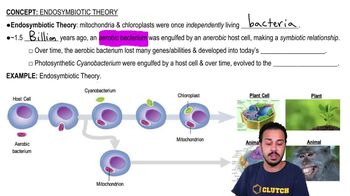
Endosymbiotic Hypothesis

The endosymbiotic hypothesis proposes that certain organelles, particularly mitochondria and chloroplasts, originated from free-living prokaryotic organisms that were engulfed by ancestral eukaryotic cells. This theory explains the double membrane structure of these organelles and their own DNA, which is similar to bacterial DNA, supporting the idea of a symbiotic relationship that evolved over time.
Recommended video:
Guided course
06:58
Endosymbiotic Theory

Mitochondria and Chloroplasts

Mitochondria are the powerhouses of the cell, responsible for producing ATP through cellular respiration, while chloroplasts are involved in photosynthesis in plant cells. Both organelles have distinct functions that are crucial for energy metabolism and are key examples of the endosymbiotic theory, as they contain their own DNA and replicate independently of the cell.
Recommended video:
Guided course
01:29
Mitochondria & Chloroplasts Example 1

Evolutionary Significance

The endosymbiotic hypothesis has significant implications for understanding the evolution of eukaryotic cells. It suggests that the complex cellular structures we see today arose from simpler prokaryotic ancestors, highlighting the importance of symbiotic relationships in evolution. This concept helps explain the diversity of life and the interdependence of different organisms.
Recommended video:
02:45
History of Evolutionary Theory Example 1