Pearson+ LogoPearson+ Logo
Ch. 14 - The Greatest Species on Earth?
Belk, Maier - Biology: Science for Life 6th Edition
Belk, Maier6th EditionBiology: Science for LifeISBN: 9780135214084Not the one you use?Change textbook
Chapter 14, Problem 5

Comparisons of ribosomal RNA among many different modern species indicate that
a. There are two very divergent groups of prokaryotes
b. The Protista represents a conglomeration of very unrelated forms
c. Fungi are more closely related to animals than to plants
d. A and B are correct
e. A, B, and C are correct

Verified step by step guidance
1
Understand the role of ribosomal RNA (rRNA) in evolutionary studies: rRNA is highly conserved across species, making it a useful molecular tool for comparing genetic relationships among organisms.
Analyze the statement 'there are two very divergent groups of prokaryotes': This refers to the discovery that prokaryotes are divided into two major domains, Bacteria and Archaea, based on rRNA comparisons.
Examine the statement 'the Protista represents a conglomeration of very unrelated forms': Protista is a diverse group of eukaryotic organisms, and rRNA studies have shown that many members of this group are not closely related, supporting this claim.
Evaluate the statement 'fungi are more closely related to animals than to plants': rRNA comparisons have revealed that fungi share a more recent common ancestor with animals than with plants, confirming this relationship.
Combine the evidence: Since all three statements (A, B, and C) are supported by rRNA comparisons, the correct answer is likely 'e. A, B, and C are correct.'

Verified video answer for a similar problem:

This video solution was recommended by our tutors as helpful for the problem above.
Video duration:
1m
Was this helpful?

Key Concepts

Here are the essential concepts you must grasp in order to answer the question correctly.

Ribosomal RNA (rRNA)

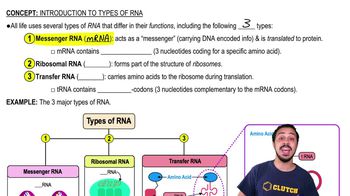
Ribosomal RNA is a type of RNA that is a fundamental component of ribosomes, the cellular machinery responsible for protein synthesis. rRNA sequences are highly conserved across different species, making them useful for phylogenetic studies. By comparing rRNA sequences, scientists can infer evolutionary relationships and divergence among various organisms.
Recommended video:
Guided course
07:20
Introduction to Types of RNA

Phylogenetics

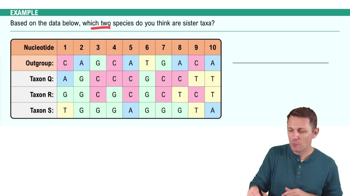
Phylogenetics is the study of evolutionary relationships among biological entities, often using genetic data to construct evolutionary trees. This field helps in understanding how different species are related through common ancestry. The analysis of rRNA sequences is a common method in phylogenetics, allowing researchers to classify organisms and determine their evolutionary lineage.
Recommended video:
04:13
Building Phylogenetic Trees Example 2

Taxonomic Groups

Taxonomic groups are categories used to classify organisms based on shared characteristics and evolutionary history. The major groups include domains (such as Bacteria, Archaea, and Eukarya) and kingdoms (like Animalia, Plantae, and Fungi). Understanding these groups is essential for interpreting the results of rRNA comparisons, as they provide context for the relationships and divergences observed among different species.
Recommended video:
Guided course
06:04
Functional Groups