Pearson+ LogoPearson+ Logo
Ch. 2 - Science Fiction, Bad Science, and Pseudoscience
Belk, Maier - Biology: Science for Life 6th Edition
Belk, Maier6th EditionBiology: Science for LifeISBN: 9780135214084Not the one you use?Change textbook
Chapter 2, Problem 1

List the four biological molecules commonly found in living organisms.

Verified step by step guidance
1
Identify the main categories of biological molecules that are essential for life processes in all living organisms.
Recognize that these molecules are often referred to as 'macromolecules' because they are large molecules composed of smaller subunits.
Note that these macromolecules can be classified into four major types based on their chemical composition and the roles they play in the cell.
List the four types of biological molecules: carbohydrates, lipids, proteins, and nucleic acids.
Understand that each type of molecule has a unique structure and function in the body, contributing to the overall health and operation of living organisms.

Verified video answer for a similar problem:

This video solution was recommended by our tutors as helpful for the problem above.
Video duration:
1m
Was this helpful?

Key Concepts

Here are the essential concepts you must grasp in order to answer the question correctly.

Carbohydrates

Carbohydrates are organic molecules composed of carbon, hydrogen, and oxygen, typically in a ratio of 1:2:1. They serve as a primary energy source for living organisms and are also important for structural functions in cells. Common examples include sugars like glucose and polysaccharides like starch and cellulose.
Recommended video:
Guided course
04:53
Carbohydrates

Proteins

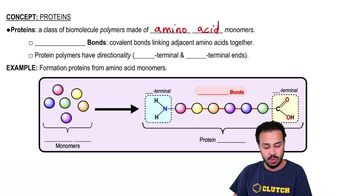
Proteins are large, complex molecules made up of amino acids linked by peptide bonds. They play crucial roles in the body, including catalyzing biochemical reactions as enzymes, providing structural support, and facilitating communication between cells. The specific sequence of amino acids determines a protein's unique structure and function.
Recommended video:

Nucleic Acids

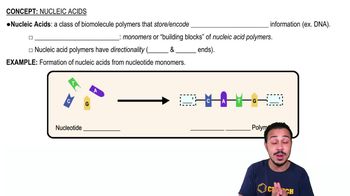
Nucleic acids, such as DNA and RNA, are polymers made up of nucleotide monomers. DNA stores and transmits genetic information, while RNA plays a key role in protein synthesis and gene expression. These molecules are essential for heredity and the functioning of all living cells.
Recommended video:
Guided course
03:22
Nucleic Acids