Pearson+ LogoPearson+ Logo
Ch. 2 - Science Fiction, Bad Science, and Pseudoscience
Belk, Maier - Biology: Science for Life 6th Edition
Belk, Maier6th EditionBiology: Science for LifeISBN: 9780135214084Not the one you use?Change textbook
Chapter 2, Problem 2

List the structural features in a prokaryotic cell.

Verified step by step guidance
1
Prokaryotic cells lack membrane-bound organelles, unlike the eukaryotic cell shown in the image. The image provided depicts a eukaryotic cell, as it contains structures such as a nucleus, mitochondria, and endoplasmic reticulum.
Prokaryotic cells have a simpler structure and include features such as a plasma membrane, which encloses the cell and regulates the movement of substances in and out of the cell.
Prokaryotic cells contain cytoplasm, a gel-like substance where cellular processes occur, and ribosomes, which are responsible for protein synthesis.
Prokaryotic cells have a nucleoid region, which contains the cell's genetic material (DNA) in a single, circular chromosome, rather than a membrane-bound nucleus.
Additional features of prokaryotic cells include a cell wall for structural support, and in some cases, structures like pili, flagella for movement, and a capsule for protection.

Verified video answer for a similar problem:

This video solution was recommended by our tutors as helpful for the problem above.
Video duration:
4m
Was this helpful?

Key Concepts

Here are the essential concepts you must grasp in order to answer the question correctly.

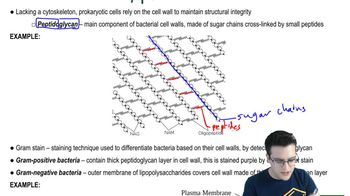
Prokaryotic Cell Structure

Prokaryotic cells are unicellular organisms that lack a membrane-bound nucleus and organelles. Their structure includes a cell membrane, cytoplasm, ribosomes, and genetic material in the form of a single circular DNA molecule. They often have a rigid cell wall, which provides shape and protection, and may possess additional features like flagella for movement.
Recommended video:
Guided course
09:28
Prokaryotic Cell Structures 1

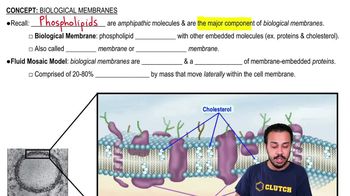
Cell Membrane

The cell membrane, or plasma membrane, is a phospholipid bilayer that surrounds the cell, providing a barrier between the internal environment and the external surroundings. It regulates the movement of substances in and out of the cell, maintaining homeostasis. Proteins embedded in the membrane facilitate communication and transport, playing crucial roles in cellular function.
Recommended video:
Guided course
06:04
Biological Membranes

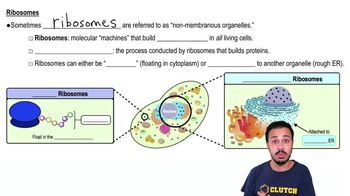
Ribosomes

Ribosomes are the molecular machines responsible for protein synthesis in all living cells. In prokaryotes, ribosomes are smaller than those in eukaryotes and float freely in the cytoplasm. They translate messenger RNA (mRNA) into polypeptide chains, which fold into functional proteins essential for various cellular processes.
Recommended video: