Pearson+ LogoPearson+ Logo
Ch. 2 - Science Fiction, Bad Science, and Pseudoscience
Belk, Maier - Biology: Science for Life 6th Edition
Belk, Maier6th EditionBiology: Science for LifeISBN: 9780135214084Not the one you use?Change textbook
Chapter 2, Problem 4

Water ________.
a. Is a good solute.
b. Facilitates chemical reactions.
c. Serves as an enzyme.
d. Makes strong covalent bonds with other molecules.
e. Consists of two oxygen and one hydrogen atoms.

Verified step by step guidance
1
Step 1: Begin by analyzing the chemical composition of water. Water (H₂O) consists of two hydrogen atoms covalently bonded to one oxygen atom. This eliminates option 'e' since it incorrectly states that water consists of two oxygen and one hydrogen atoms.
Step 2: Evaluate the statement 'a. is a good solute.' A solute is a substance that dissolves in a solvent. Water is not a solute; it is a solvent, meaning it dissolves other substances. Therefore, option 'a' is incorrect.
Step 3: Consider the statement 'b. facilitates chemical reactions.' Water is known as a universal solvent and plays a critical role in facilitating chemical reactions, especially in biological systems, by dissolving reactants and enabling interactions. This option is plausible.
Step 4: Examine the statement 'c. serves as an enzyme.' Enzymes are biological catalysts made of proteins or RNA that speed up chemical reactions. Water is not an enzyme, so option 'c' is incorrect.
Step 5: Assess the statement 'd. makes strong covalent bonds with other molecules.' Water forms hydrogen bonds with other molecules, not strong covalent bonds. Covalent bonds occur within the water molecule itself, between hydrogen and oxygen atoms. Thus, option 'd' is incorrect.

Verified video answer for a similar problem:

This video solution was recommended by our tutors as helpful for the problem above.
Video duration:
1m
Was this helpful?

Key Concepts

Here are the essential concepts you must grasp in order to answer the question correctly.

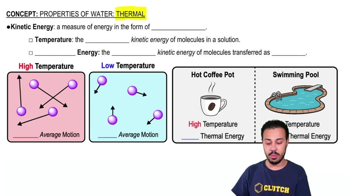
Properties of Water

Water is a polar molecule, which means it has a partial positive charge on one side and a partial negative charge on the other. This polarity allows water to dissolve many substances, making it an excellent solvent. Its unique properties, such as high specific heat and surface tension, are crucial for supporting life and facilitating various biological processes.
Recommended video:
Guided course
04:07
Properties of Water- Thermal

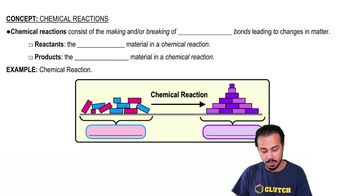
Role of Water in Chemical Reactions

Water plays a vital role in biochemical reactions, often acting as a medium where these reactions occur. It participates in hydrolysis and condensation reactions, which are essential for breaking down and synthesizing biomolecules. Additionally, water's ability to stabilize temperature helps maintain homeostasis in living organisms.
Recommended video:
Guided course
01:56
Chemical Reactions

Molecular Composition of Water

Water is composed of two hydrogen atoms covalently bonded to one oxygen atom, forming the chemical formula H2O. This molecular structure is responsible for water's unique properties, including its high polarity and ability to form hydrogen bonds. These characteristics are fundamental to its role in biological systems, influencing everything from cellular structure to metabolic processes.
Recommended video:
Guided course
06:13
Soil Composition