Pearson+ LogoPearson+ Logo
Ch. 5 - Life in the Greenhouse
Belk, Maier - Biology: Science for Life 6th Edition
Belk, Maier6th EditionBiology: Science for LifeISBN: 9780135214084Not the one you use?Change textbook
Chapter 5, Problem 7

Which of the following is a false statement about photosynthesis?
a. During the light-independent reactions, electrons and ATP from the light reactions combine with atmospheric carbon dioxide to produce sugars.
b. The light-independent reactions take place in the chloroplast stroma.
c. Oxygen produced during the light-independent reactions is released into the atmosphere.
d. Chlorophyll absorbs blue and red light and reflects green light.
e. The end product of photosynthesis is a carbohydrate such as glucose.

Verified step by step guidance
1
Step 1: Begin by understanding the two main stages of photosynthesis: the light-dependent reactions and the light-independent reactions (Calvin cycle). The light-dependent reactions occur in the thylakoid membranes and produce ATP, NADPH, and oxygen as a byproduct. The light-independent reactions occur in the stroma and use ATP and NADPH to convert carbon dioxide into sugars.
Step 2: Analyze each statement provided in the question to determine its accuracy based on your knowledge of photosynthesis. For example, statement (a) mentions the role of ATP and electrons in the light-independent reactions, which is correct. Statement (b) correctly identifies the location of the light-independent reactions in the chloroplast stroma.
Step 3: Evaluate statement (c), which claims that oxygen is produced during the light-independent reactions. Recall that oxygen is actually produced during the light-dependent reactions as a result of water splitting (photolysis). This makes statement (c) false.
Step 4: Review statement (d), which describes chlorophyll's absorption of blue and red light and reflection of green light. This is accurate and aligns with the properties of chlorophyll pigments.
Step 5: Confirm statement (e), which states that the end product of photosynthesis is a carbohydrate such as glucose. This is correct, as glucose is synthesized during the Calvin cycle using carbon dioxide, ATP, and NADPH.

Verified video answer for a similar problem:

This video solution was recommended by our tutors as helpful for the problem above.
Video duration:
54s
Was this helpful?

Key Concepts

Here are the essential concepts you must grasp in order to answer the question correctly.

Photosynthesis Overview

Photosynthesis is the process by which green plants, algae, and some bacteria convert light energy into chemical energy, specifically glucose, using carbon dioxide and water. This process occurs primarily in the chloroplasts of plant cells and involves two main stages: the light-dependent reactions and the light-independent reactions (Calvin cycle).
Recommended video:
Guided course
05:58
Pigments of Photosynthesis

Light-Dependent and Light-Independent Reactions

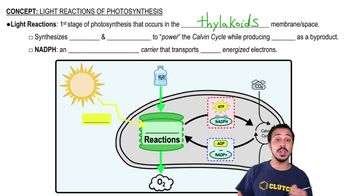
The light-dependent reactions occur in the thylakoid membranes of chloroplasts, where sunlight is captured to produce ATP and NADPH, releasing oxygen as a byproduct. The light-independent reactions, or Calvin cycle, take place in the stroma, utilizing ATP and NADPH to convert carbon dioxide into glucose. Understanding the distinction between these two stages is crucial for analyzing statements about photosynthesis.
Recommended video:
Guided course
04:06
Light Reactions of Photosynthesis

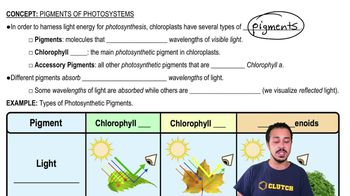
Role of Chlorophyll

Chlorophyll is the green pigment found in chloroplasts that plays a vital role in photosynthesis by absorbing light energy, primarily in the blue and red wavelengths, while reflecting green light. This absorption of light energy is essential for driving the light-dependent reactions, which ultimately contribute to the synthesis of carbohydrates during photosynthesis.
Recommended video:
Guided course
05:58
Pigments of Photosynthesis
Related Practice
Textbook Question

The burning of fossil fuels ________.

a. Releases carbon dioxide to the atmosphere.

b. Primarily occurs as a result of human activity.

c. Is contributing to global warming.

d. Is possible thanks to photosynthesis that occurred millions of years ago.

e. All of the above are correct.

2434
views
Textbook Question

Stomata on a plant's surface ________.

a. Prevent oxygen from escaping.

b. Produce water as a result of photosynthesis.

c. Cannot be regulated by the plant.

d. Allow carbon dioxide uptake into leaves.

e. Are found in stacks called thylakoids.

937
views
1
rank
Textbook Question

Which of the following does not occur during the light reactions of photosynthesis?

a. Water is released.

b. Electrons from chlorophyll are moved to a higher-energy state by light.

c. ATP is produced.

d. NADPH is produced to carry electrons to the light-independent reactions.

e. Oxygen is produced when water is split.

2265
views
Textbook Question

Which of the following human activities generates the most carbon dioxide?

a. Driving

b. Cooking

c. Bathing

d. Using aerosol sprays

907
views
Textbook Question

Photorespiration occurs ________.

a. Under hot and dry conditions.

b. When oxygen is incorporated in the first step of the light-independent reactions.

c. When carbon dioxide levels are high inside the plant.

d. A and B are correct.

e. A, B, and C are correct.

1268
views
Textbook Question

Select the true statement regarding metabolism in plant and animal cells.

a. Plant and animal cells both perform photosynthesis and aerobic respiration.

b. Animal cells perform aerobic respiration only, and plant cells perform photosynthesis only.

c. Plant cells perform aerobic respiration only, and animal cells perform photosynthesis only.

d. Plant cells perform cellular respiration and photosynthesis, and animal cells perform aerobic respiration only.

1807
views