Pearson+ LogoPearson+ Logo
Ch. 6 - Cancer
Belk, Maier - Biology: Science for Life 6th Edition
Belk, Maier6th EditionBiology: Science for LifeISBN: 9780135214084Not the one you use?Change textbook
Chapter 6, Problem 2

Add labels to the figure that follows, which illustrates duplicated chromosomes.
Microscopic image of bacteria showing labeled structures related to DNA organization.

Verified step by step guidance
1
Step 1: Identify the structure labeled '1' in the first image. This represents the duplicated chromosomes, which consist of two identical sister chromatids joined together.
Step 2: Label the structure marked '2' in the first image. This is the centromere, the region where the sister chromatids are tightly connected and where spindle fibers attach during cell division.
Step 3: Label the structure marked '3' in the first image. These are the sister chromatids, which are identical copies of the chromosome formed during DNA replication.
Step 4: In the second image, identify the bracketed region. This represents the duplicated chromosome, which includes two sister chromatids.
Step 5: Label the pointed region in the second image. This is the centromere, the constricted area where the chromatids are joined and spindle fibers attach during mitosis or meiosis.

Verified video answer for a similar problem:

This video solution was recommended by our tutors as helpful for the problem above.
Video duration:
1m
Was this helpful?

Key Concepts

Here are the essential concepts you must grasp in order to answer the question correctly.

Chromosome Structure

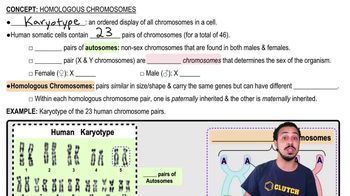
Chromosomes are long, thread-like structures made of DNA and proteins that carry genetic information. In eukaryotic cells, chromosomes are linear and exist in pairs, while in prokaryotes, they are typically circular. The image depicts duplicated chromosomes, which consist of two sister chromatids joined at a region called the centromere, essential for accurate cell division.
Recommended video:
Guided course
08:09
Homologous Chromosomes

DNA Replication

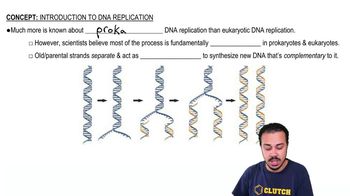
DNA replication is the biological process of producing two identical replicas of DNA from one original DNA molecule. This process is crucial during cell division, ensuring that each daughter cell receives an exact copy of the genetic material. The image illustrates chromosomes that have undergone replication, showing the duplicated structure necessary for mitosis or meiosis.
Recommended video:
Guided course
03:37
Introduction to DNA Replication

Cell Division

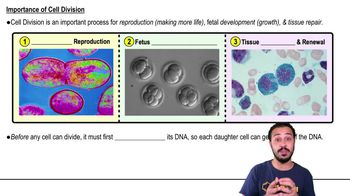
Cell division is the process by which a parent cell divides into two or more daughter cells. In eukaryotes, this occurs through mitosis (for somatic cells) or meiosis (for gametes). The duplicated chromosomes in the image are vital for this process, as they ensure that genetic information is accurately distributed to the daughter cells during division.
Recommended video:
Guided course
03:19
Importance of Cell Division