
Pearson+ LogoPearson+ Logo
Ch. 6 - Cancer
Belk, Maier - Biology: Science for Life 6th Edition
Belk, Maier6th EditionBiology: Science for LifeISBN: 9780135214084Not the one you use?Change textbook
Chapter 6, Problem 9

If a cell at G1 contains four picograms of DNA, how many picograms of DNA will it contain at the end of the S phase of the cell cycle?
a. 0
b. 2
c. 4
d. 8

Verified step by step guidance
1
Understand the cell cycle phases: The G1 phase is the first gap phase where the cell grows and prepares for DNA replication. The S phase (synthesis phase) is where DNA replication occurs, doubling the amount of DNA in the cell.
Identify the amount of DNA in the cell during G1: The problem states that the cell contains 4 picograms of DNA during the G1 phase.
Recognize what happens during the S phase: During the S phase, the DNA is replicated, meaning the amount of DNA doubles to ensure that each daughter cell will receive a complete set of genetic material after cell division.
Calculate the DNA content at the end of the S phase: To determine the DNA content, multiply the amount of DNA in G1 by 2. Use the formula: DNA=G1×2.
Conclude the DNA content: After the S phase, the cell will contain twice the amount of DNA it had in G1. This step ensures understanding of the doubling process during DNA replication.

Verified video answer for a similar problem:

This video solution was recommended by our tutors as helpful for the problem above.
Video duration:
1m
Was this helpful?

Key Concepts

Here are the essential concepts you must grasp in order to answer the question correctly.

Cell Cycle

The cell cycle is a series of phases that a cell goes through to grow and divide. It consists of interphase (which includes G1, S, and G2 phases) and the mitotic phase. During interphase, the cell prepares for division, and the S phase is specifically when DNA replication occurs, doubling the amount of DNA in the cell.
Recommended video:
Guided course
03:31
Cell Cycle Regulation

DNA Replication

DNA replication is the biological process of producing two identical replicas of DNA from one original DNA molecule. This process occurs during the S phase of the cell cycle, where each chromosome is duplicated, resulting in two sister chromatids for each chromosome, effectively doubling the total amount of DNA present in the cell.
Recommended video:
Guided course
03:37
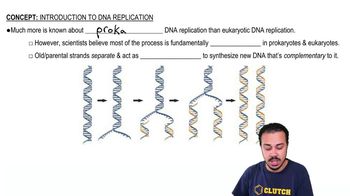
Introduction to DNA Replication

Picogram Measurement

A picogram is a unit of mass equal to one trillionth of a gram (10^-12 grams). In the context of DNA measurement, it is used to quantify the amount of DNA present in a cell. Understanding this measurement is crucial for interpreting the amount of DNA before and after the S phase, as it helps in calculating the total DNA content after replication.
Recommended video:
Guided course
09:21
Biome and Biomass