Ch. 1 - Functions
Briggs - Calculus: Early Transcendentals 3rd Edition
Briggs3rd EditionCalculus: Early TranscendentalsISBN: 9780136847243Not the one you use?Change textbook
Chapter 1, Problem 89c

{Use of Tech} Sum of squared integers Let T (n) = 1² + 2² + ... + n², where n is a positive integer. It can be shown that T (n) = n (n + 1) (2n + 1) / 8


c. What is the least value of n for which T(n) > 1000?

Verified step by step guidance
1
Step 1: Understand the problem. We need to find the smallest positive integer n such that the sum of the squares of the first n integers, T(n), is greater than 1000. The formula for T(n) is given as T(n) = \( \frac{n(n + 1)(2n + 1)}{6} \).
Step 2: Set up the inequality. We want T(n) > 1000, so substitute the formula into the inequality: \( \frac{n(n + 1)(2n + 1)}{6} > 1000 \).
Step 3: Clear the fraction by multiplying both sides of the inequality by 6 to get: n(n + 1)(2n + 1) > 6000.
Step 4: Solve the inequality. This involves finding the smallest integer n that satisfies the inequality. You can start by testing integer values of n to see when the inequality holds true.
Step 5: Verify your solution. Once you find a candidate for n, substitute it back into the original formula for T(n) to ensure that T(n) > 1000.

Verified video answer for a similar problem:
This video solution was recommended by our tutors as helpful for the problem above.
Video duration:
4m

Key Concepts

Here are the essential concepts you must grasp in order to answer the question correctly.

Sum of Squares Formula

The sum of the squares of the first n positive integers is given by the formula T(n) = n(n + 1)(2n + 1) / 6. This formula allows for the efficient calculation of the sum without needing to manually add each squared integer, which is particularly useful for large values of n.
Recommended video:
Guided course
06:11
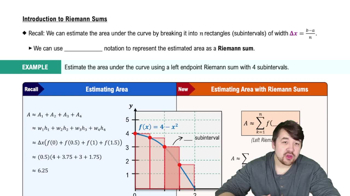
Introduction to Riemann Sums

Inequalities

An inequality is a mathematical statement that compares two expressions, indicating that one is greater than, less than, or not equal to the other. In this context, solving T(n) > 1000 requires finding the smallest integer n such that the sum of squares exceeds 1000, which involves manipulating the inequality to isolate n.
Recommended video:
Guided course
5:10
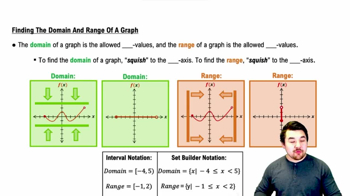
Finding the Domain and Range of a Graph

Integer Solutions

In many mathematical problems, especially those involving sums or sequences, we often seek integer solutions. For this question, we need to find the least positive integer n that satisfies the inequality, which may involve testing successive integer values or using numerical methods to find the threshold where T(n) first exceeds 1000.
Recommended video:
Guided course
04:22
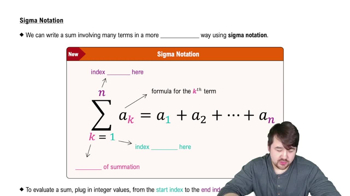
Sigma Notation