Ch. 8 - Integration Techniques
Briggs - Calculus: Early Transcendentals 3rd Edition
Briggs3rd EditionCalculus: Early TranscendentalsISBN: 9780136847243Not the one you use?Change textbook
Chapter 8, Problem 8.1.7

7–64. Integration review Evaluate the following integrals.
7. ∫ dx / (3 - 5x)^4

Verified step by step guidance
1
Recognize that the integral ∫ dx / (3 - 5x)^4 involves a rational function with a power of a linear term in the denominator. This suggests using a substitution to simplify the integral.
Let u = 3 - 5x. Then, compute the derivative of u with respect to x: du/dx = -5, or equivalently, dx = -du/5.
Substitute u and dx into the integral. The integral becomes ∫ (-1/5) du / u^4, where the factor -1/5 comes from the substitution for dx.
Simplify the integral to ∫ -1/5 * u^(-4) du. Rewrite the integrand as -1/5 * u^(-4) to prepare for applying the power rule of integration.
Apply the power rule for integration: ∫ u^n du = u^(n+1) / (n+1), for n ≠ -1. Here, n = -4, so the integral becomes (-1/5) * (u^(-4+1) / (-4+1)). Simplify the expression and substitute back u = 3 - 5x to return to the original variable.

Verified video answer for a similar problem:

This video solution was recommended by our tutors as helpful for the problem above.
Video duration:
4m
Was this helpful?

Key Concepts

Here are the essential concepts you must grasp in order to answer the question correctly.

Integration Techniques

Integration techniques are methods used to find the integral of a function. Common techniques include substitution, integration by parts, and partial fractions. In this case, substitution is particularly useful for simplifying the integral of a rational function, allowing for easier evaluation.
Recommended video:
06:18
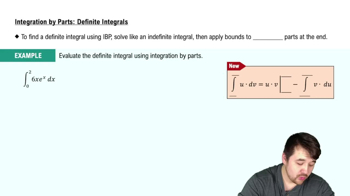
Integration by Parts for Definite Integrals

Substitution Method

The substitution method involves replacing a variable in the integral with another variable to simplify the expression. For the integral ∫ dx / (3 - 5x)^4, we can let u = 3 - 5x, which transforms the integral into a more manageable form. This method is essential for integrals involving composite functions.
Recommended video:
07:33
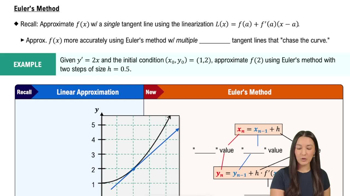
Euler's Method

Power Rule for Integration

The power rule for integration states that ∫ x^n dx = (x^(n+1))/(n+1) + C, where n ≠ -1. This rule is applicable when integrating functions of the form u^n, where u is a function of x. In the given integral, after substitution, applying the power rule will help in finding the antiderivative of the transformed function.
Recommended video:
04:04
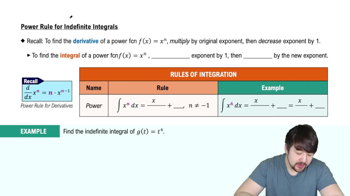
Power Rule for Indefinite Integrals