A cost function of the form C(x) = 1/2x² reflects diminishing returns to scale. Find and graph the cost, average cost, and marginal cost functions. Interpret the graphs and explain the idea of diminishing returns.
Ch. 3 - Derivatives
Briggs3rd EditionCalculus: Early TranscendentalsISBN: 9780136847243Not the one you use?Change textbook
Chapter 3, Problem 3.5.64
Find y'' for the following functions.
y = cos θ sin θ
Verified step by step guidance1
First, recognize that the function y = cos(θ) sin(θ) is a product of two functions. To find the derivative, we will use the product rule, which states that if y = u*v, then y' = u'v + uv'.
Identify u = cos(θ) and v = sin(θ). Compute the derivatives u' and v'. The derivative of cos(θ) is -sin(θ), and the derivative of sin(θ) is cos(θ).
Apply the product rule: y' = (-sin(θ)) * sin(θ) + cos(θ) * cos(θ). Simplify this expression to get y'.
Now, to find y'', differentiate y' again. Use the sum rule and the chain rule as needed. Differentiate each term separately: for the first term, differentiate -sin(θ) * sin(θ), and for the second term, differentiate cos(θ) * cos(θ).
Combine the derivatives from the previous step to obtain y''. Simplify the expression to get the second derivative of y with respect to θ.

Verified video answer for a similar problem:
This video solution was recommended by our tutors as helpful for the problem above.
Video duration:
4mWas this helpful?
Key Concepts
Here are the essential concepts you must grasp in order to answer the question correctly.
Second Derivative
The second derivative of a function measures the rate of change of the first derivative, providing information about the curvature of the function's graph. It is denoted as y'' and is essential for analyzing the concavity and inflection points of the function. In this context, finding y'' involves differentiating the function twice with respect to the variable.
Recommended video:
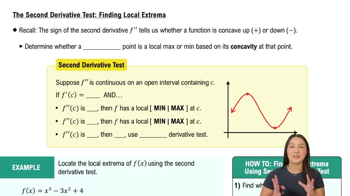
The Second Derivative Test: Finding Local Extrema
Trigonometric Functions
Trigonometric functions, such as sine and cosine, are fundamental in calculus, especially when dealing with periodic phenomena. The function y = cos(θ) sin(θ) is a product of these functions, and understanding their derivatives requires applying the product rule. Familiarity with the properties and derivatives of sine and cosine is crucial for solving the problem.
Recommended video:
Introduction to Trigonometric Functions
Product Rule
The product rule is a formula used to find the derivative of the product of two functions. It states that if u and v are functions of θ, then the derivative of their product is given by u'v + uv'. This rule is particularly relevant for differentiating y = cos(θ) sin(θ), as it allows for the correct application of calculus to find the first and subsequently the second derivative.
Recommended video:
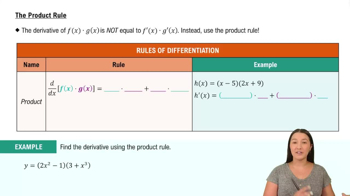
The Product Rule
Related Practice
Textbook Question
202
views
Textbook Question
Evaluate the derivative of the following functions.
f(x) = sin-1 (e-2x)
204
views
Textbook Question
Find the derivative of the following functions.
y = In √x⁴+x²
237
views
Textbook Question
Find the function The following limits represent the slope of a curve y = f(x) at the point (a,f(a)). Determine a possible function f and number a; then calculate the limit.
(lim h🠂0) (2+h)⁴-16 / h
174
views
Textbook Question
Derivatives of products and quotients Find the derivative of the following functions by first expanding or simplifying the expression. Simplify your answers.
h(x) = √x (√x-x³/²)
220
views
Textbook Question
Find the slope of the curve y=sin-1 x at (1/2, π/6) without calculating the derivative of sin-1 x.
177
views