Ch. 3 - Derivatives
Hass - Thomas' Calculus 15th Edition
Hass15th EditionThomas' CalculusISBN: 9780137616077Not the one you use?Change textbook
Chapter 3, Problem 3.7.16

Find dr/dθ in Exercises 15–18.


r – 2√θ = (3/2)θ²/³ + (4/3)θ³/⁴

Verified step by step guidance
1
Start by identifying the given equation: r - 2√θ = (3/2)θ²/³ + (4/3)θ³/⁴. We need to find dr/dθ, which is the derivative of r with respect to θ.
Rearrange the equation to express r explicitly in terms of θ: r = 2√θ + (3/2)θ²/³ + (4/3)θ³/⁴.
Differentiate each term of the equation with respect to θ. For the term 2√θ, use the derivative of θ^(1/2), which is (1/2)θ^(-1/2).
For the term (3/2)θ²/³, apply the power rule: the derivative is (3/2) * (2/3)θ^(2/3 - 1). Simplify this expression.
For the term (4/3)θ³/⁴, again use the power rule: the derivative is (4/3) * (3/4)θ^(3/4 - 1). Simplify this expression. Combine all the derivatives to find dr/dθ.

Verified video answer for a similar problem:

This video solution was recommended by our tutors as helpful for the problem above.
Video duration:
3m
Was this helpful?

Key Concepts

Here are the essential concepts you must grasp in order to answer the question correctly.

Implicit Differentiation

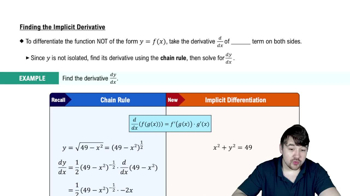
Implicit differentiation is a technique used to find the derivative of a function when it is not explicitly solved for one variable in terms of another. In this problem, r is given implicitly in terms of θ, so we differentiate both sides of the equation with respect to θ, treating r as a function of θ, and then solve for dr/dθ.
Recommended video:
05:14
Finding The Implicit Derivative

Power Rule for Differentiation

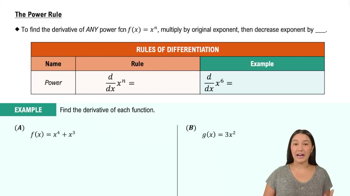
The power rule is a basic rule in calculus used to differentiate functions of the form x^n, where n is a real number. The derivative of x^n is n*x^(n-1). In this problem, terms like θ^(2/3) and θ^(3/4) require applying the power rule to find their derivatives with respect to θ.
Recommended video:
04:02
The Power Rule

Chain Rule

The chain rule is used to differentiate composite functions. It states that the derivative of a composite function f(g(x)) is f'(g(x)) * g'(x). In this context, when differentiating terms involving θ raised to a power, the chain rule helps in handling the differentiation of nested functions, especially when θ is under a radical or fractional exponent.
Recommended video:
05:02
Intro to the Chain Rule