Ch. 2 - Limits
Briggs - Calculus: Early Transcendentals 3rd Edition
Briggs3rd EditionCalculus: Early TranscendentalsISBN: 9780136847243Not the one you use?Change textbook
Chapter 2, Problem 2.7.58

Use the definitions given in Exercise 57 to prove the following infinite limits.


lim x→1^+ 1 /1 − x=−∞

Verified step by step guidance
1
Understand the problem: We need to prove that as x approaches 1 from the right (x → 1^+), the expression 1/(1-x) approaches negative infinity.
Consider the behavior of the denominator (1-x) as x approaches 1 from the right. Since x is slightly greater than 1, (1-x) becomes a small negative number.
Analyze the fraction 1/(1-x): As (1-x) becomes a small negative number, the fraction 1/(1-x) becomes a large negative number because dividing by a small negative number results in a large negative value.
Formalize the limit: For any large negative number M, we need to find a δ > 0 such that for all x satisfying 0 < x - 1 < δ, the inequality 1/(1-x) < M holds true.
Conclude the proof: By choosing δ = 1 - (1/M), we ensure that as x approaches 1 from the right, 1/(1-x) becomes less than any large negative number M, thus proving the limit is negative infinity.

Verified video answer for a similar problem:

This video solution was recommended by our tutors as helpful for the problem above.
Video duration:
5m
Was this helpful?

Key Concepts

Here are the essential concepts you must grasp in order to answer the question correctly.

Infinite Limits

Infinite limits describe the behavior of a function as it approaches a certain point, where the function's value increases or decreases without bound. In this case, as x approaches 1 from the right (1+), the function 1/(1-x) tends toward negative infinity, indicating that the values of the function decrease indefinitely.
Recommended video:
05:50
One-Sided Limits

One-Sided Limits

One-sided limits focus on the behavior of a function as it approaches a specific point from one direction only. The notation lim x→1^+ indicates that we are considering values of x that are greater than 1, which is crucial for understanding how the function behaves as it nears the point of interest from the right side.
Recommended video:
05:50
One-Sided Limits

Understanding the Function's Behavior

To analyze the limit lim x→1^+ 1/(1-x), it is essential to understand how the denominator behaves as x approaches 1 from the right. As x gets closer to 1, 1-x approaches 0, causing the fraction to grow larger in magnitude and negative, leading to the conclusion that the limit is negative infinity.
Recommended video:
5:46
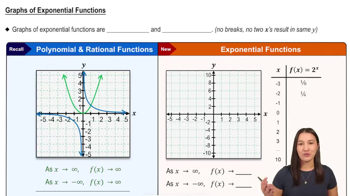
Graphs of Exponential Functions
Related Practice
Textbook Question

Determine the end behavior of the following transcendental functions by analyzing appropriate limits. Then provide a simple sketch of the associated graph, showing asymptotes if they exist. 

f(x)=sinxf\(\left\)(x\(\right\))=\(\sin\) x

350
views
Textbook Question

If a function f represents a system that varies in time, the existence of lim limtf(t){\(\displaystyle\[\lim\)_{t\(\rightarrow\]\infty\)}{f(t)}} means that the system reaches a steady state (or equilibrium). For the following systems, determine whether a steady state exists and give the steady-state value.


The population of a culture of tumor cells is given by p(t)=3500tt+1p\(\left\)(t\(\right\))=\(\frac{3500t}{t+1}\).

372
views
Textbook Question

Find the following limits or state that they do not exist. Assume a, b , c, and k are fixed real numbers.

lim x→3 x − 3 /|x − 3|

243
views
Textbook Question

Evaluate each limit and justify your answer. 

lim x→2 (3 / 2x^5−4x^2−50)^4

349
views
Textbook Question

Find all vertical asymptotes x=ax=a of the following functions. For each value of aa, determine limxa+f(x){\(\displaystyle\]\lim\)_{x\(\to\) a^{+}}}f\(\left\)(x\(\right\)), limxaf(x){\(\displaystyle\]\lim\)_{x\(\to\) a^{-}}}f\(\left\)(x\(\right\)), and limxaf(x){\(\displaystyle\]\lim\)_{x\(\to\) a}}f\(\left\)(x\(\right\)).

f(x)=x+1x34x2+4xf\(\left\)(x\(\right\))=\(\frac{x+1}{x^3-4x^2+4x}\)

347
views
Textbook Question

Use the precise definition of infinite limits to prove the following limits.


limx0(1x4sin(x))={\(\displaystyle\[\lim\)_{x\(\to\)0}}\(\left\)(\(\frac{1}{x^4}\)-\(\sin\]\left\)(x\(\right\))\(\right\))=\(\infty\)

322
views