Ch. 5 - Integration
Briggs - Calculus: Early Transcendentals 3rd Edition
Briggs3rd EditionCalculus: Early TranscendentalsISBN: 9780136847243Not the one you use?Change textbook
Chapter 5, Problem 5.3.8

Why can the constant of integration be omitted from the antiderivative when evaluating a definite integral?

Verified step by step guidance
1
Understand the concept of a definite integral: A definite integral calculates the net area under a curve between two specific bounds, say from x = a to x = b. It results in a numerical value rather than a general function.
Recall the Fundamental Theorem of Calculus: The definite integral of a function f(x) from a to b is computed using an antiderivative F(x), such that \( \int_a^b f(x) \, dx = F(b) - F(a) \).
Recognize the role of the constant of integration: When finding an antiderivative, a constant of integration (C) is added because indefinite integrals represent a family of functions. However, for definite integrals, this constant cancels out during subtraction.
Perform the subtraction step: When evaluating \( F(b) - F(a) \), the constant of integration (C) appears in both F(b) and F(a). Since \( C - C = 0 \), the constant does not affect the final result of the definite integral.
Conclude why the constant can be omitted: Because the constant of integration cancels out during the subtraction process, it is unnecessary to include it when evaluating a definite integral.

Verified video answer for a similar problem:

This video solution was recommended by our tutors as helpful for the problem above.
Video duration:
2m
Was this helpful?

Key Concepts

Here are the essential concepts you must grasp in order to answer the question correctly.

Definite Integral

A definite integral calculates the net area under a curve between two specified limits. It is represented as ∫[a, b] f(x) dx, where 'a' and 'b' are the bounds of integration. The result is a numerical value that reflects the accumulation of quantities, such as area, over the interval [a, b].
Recommended video:
05:43
Definition of the Definite Integral

Antiderivative

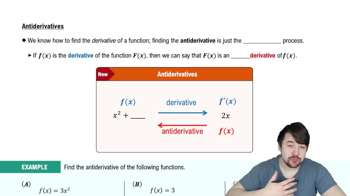
An antiderivative of a function f(x) is a function F(x) such that F'(x) = f(x). When finding an antiderivative, we often include a constant of integration (C) because the derivative of a constant is zero, meaning multiple functions can yield the same derivative. However, this constant does not affect the evaluation of definite integrals.
Recommended video:
05:50
Antiderivatives

Fundamental Theorem of Calculus

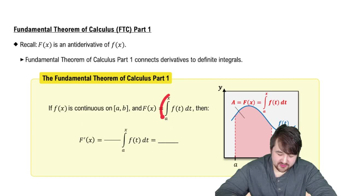
The Fundamental Theorem of Calculus links differentiation and integration, stating that if F is an antiderivative of f on an interval [a, b], then ∫[a, b] f(x) dx = F(b) - F(a). This theorem shows that when evaluating a definite integral, the constant of integration cancels out, as it is present in both F(b) and F(a), making it unnecessary for the final result.
Recommended video:
06:11
Fundamental Theorem of Calculus Part 1
Related Practice
Textbook Question

{Use of Tech} Areas of regions Find the area of the region 𝑅 bounded by the graph of Ζ’ and the 𝓍-axis on the given interval. Graph Ζ’ and show the region 𝑅.                                              


 Ζ’(𝓍) = 2 ― |𝓍| on [ ― 2 , 4]

74
views
Textbook Question

Indefinite integrals Use a change of variables or Table 5.6 to evaluate the following indefinite integrals. Check your work by differentiating.                                                                                  


 βˆ« (sin⁡ 𝓍 + 3 sinΒ³ 𝓍― sin 𝓍) cos 𝓍 d𝓍

74
views
Textbook Question

The linear function Ζ’(𝓍) = 3 ― 𝓍 is decreasing on the interval [0, 3]. Is its area function for Ζ’ (with left endpoint 0) increasing or decreasing on the interval [0, 3]? Draw a picture and explain. 

75
views
Textbook Question

Definite integrals from graphs The figure shows the areas of regions bounded by the graph of Ζ’ and the 𝓍-axis. Evaluate the following integrals.


βˆ«β‚€αΆœ |Ζ’(𝓍)| d𝓍

143
views
Textbook Question

Symmetry of composite functions Prove that the integrand is either even or odd. Then give the value of the integral or show how it can be simplified. Assume f and g are even functions and p and q are odd functions.

βˆ«α΅ƒβ‚‹β‚ Ζ’(p(𝓍)) d𝓍

110
views
Textbook Question

Suppose the interval [1, 3] is partitioned into n = 4 subintervals. What is the subinterval length βˆ†π“? List the grid points xβ‚€ , x₁ , xβ‚‚ , x₃ and xβ‚„. Which points are used for the left, right, and midpoint Riemann sums?

85
views