Ch. 3 - Derivatives
Briggs - Calculus: Early Transcendentals 3rd Edition
Briggs3rd EditionCalculus: Early TranscendentalsISBN: 9780136847243Not the one you use?Change textbook
Chapter 3, Problem 3.5.9

Find d²/dx² (sin x + cos x).

Verified step by step guidance
1
First, identify the function you need to differentiate: f(x) = sin(x) + cos(x).
Calculate the first derivative, f'(x), by differentiating each term separately. The derivative of sin(x) is cos(x), and the derivative of cos(x) is -sin(x). Therefore, f'(x) = cos(x) - sin(x).
Now, find the second derivative, f''(x), by differentiating f'(x). Differentiate cos(x) to get -sin(x) and differentiate -sin(x) to get -cos(x).
Combine the results from the previous step to express the second derivative: f''(x) = -sin(x) - cos(x).
Review the process to ensure each differentiation step was applied correctly, confirming that the second derivative of the original function is f''(x) = -sin(x) - cos(x).

Verified video answer for a similar problem:

This video solution was recommended by our tutors as helpful for the problem above.
Video duration:
2m
Was this helpful?

Key Concepts

Here are the essential concepts you must grasp in order to answer the question correctly.

Differentiation

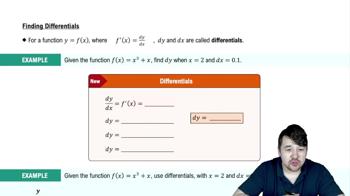
Differentiation is the process of finding the derivative of a function, which represents the rate of change of the function with respect to a variable. In this context, we need to differentiate the function sin x + cos x to find its first derivative, which will then be differentiated again to obtain the second derivative.
Recommended video:
05:53
Finding Differentials

Second Derivative

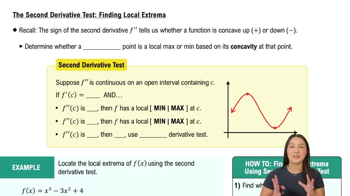
The second derivative of a function is the derivative of the first derivative. It provides information about the curvature of the function and can indicate concavity. In this case, calculating d²/dx² (sin x + cos x) involves taking the derivative of the first derivative to analyze how the rate of change itself is changing.
Recommended video:
06:02
The Second Derivative Test: Finding Local Extrema

Trigonometric Derivatives

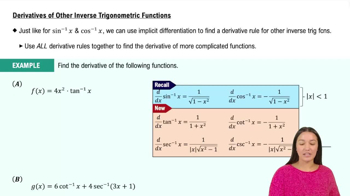
Trigonometric derivatives are specific rules for differentiating trigonometric functions. For example, the derivative of sin x is cos x, and the derivative of cos x is -sin x. Understanding these derivatives is essential for solving the given problem, as they will be applied to find both the first and second derivatives of the function sin x + cos x.
Recommended video:
06:35
Derivatives of Other Inverse Trigonometric Functions