
Ch. 5 - Integration
Briggs - Calculus: Early Transcendentals 3rd Edition
Briggs3rd EditionCalculus: Early TranscendentalsISBN: 9780136847243Not the one you use?Change textbook
Chapter 5, Problem 5.5.15b

Use Table 5.6 to evaluate the following indefinite integrals.                                                                                                               
                                                                                                                                                                  
 (b) ∫ sec 5𝓍 tan 5𝓍 d𝓍

Verified step by step guidance
1
Step 1: Recognize the integral ∫ sec(5𝓍) tan(5𝓍) d𝓍 as a standard form listed in Table 5.6. The integral of sec(u) tan(u) with respect to u is sec(u).
Step 2: Identify the inner function u = 5𝓍. This substitution is necessary because the argument of sec and tan is 5𝓍, not just 𝓍.
Step 3: Compute the derivative of u with respect to 𝓍, which is du/d𝓍 = 5. Rearrange to express d𝓍 in terms of du: d𝓍 = du/5.
Step 4: Substitute u = 5𝓍 and d𝓍 = du/5 into the integral. The integral becomes (1/5) ∫ sec(u) tan(u) du.
Step 5: Apply the standard result from Table 5.6: ∫ sec(u) tan(u) du = sec(u). Replace u with 5𝓍 to return to the original variable, yielding (1/5) sec(5𝓍) + C, where C is the constant of integration.

Verified video answer for a similar problem:

This video solution was recommended by our tutors as helpful for the problem above.
Video duration:
1m
Was this helpful?

Key Concepts

Here are the essential concepts you must grasp in order to answer the question correctly.

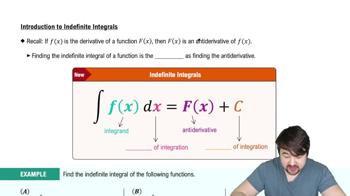
Indefinite Integrals

Indefinite integrals represent a family of functions whose derivative is the integrand. They are expressed with a constant of integration, typically denoted as 'C'. The process of finding an indefinite integral is known as integration, which is the reverse operation of differentiation. Understanding the properties and rules of integration is essential for evaluating integrals accurately.
Recommended video:
05:04
Introduction to Indefinite Integrals

Integration Techniques

Various techniques exist for evaluating integrals, including substitution, integration by parts, and using trigonometric identities. For integrals involving trigonometric functions, recognizing patterns and applying specific formulas can simplify the process. Mastery of these techniques allows for the effective evaluation of more complex integrals, such as those involving secant and tangent functions.
Recommended video:
06:18
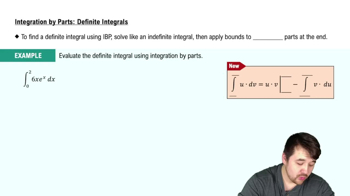
Integration by Parts for Definite Integrals

Trigonometric Integrals

Trigonometric integrals involve the integration of functions that include trigonometric identities, such as sine, cosine, secant, and tangent. Specific integrals, like ∫ sec(x) tan(x) dx, have known results that can be directly applied. Familiarity with these standard integrals, often found in integral tables, is crucial for quickly solving problems involving trigonometric functions.
Recommended video:
6:04
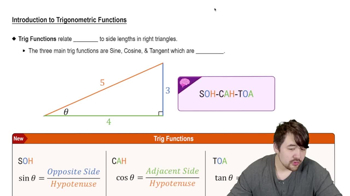
Introduction to Trigonometric Functions