Ch. 4 - Applications of the Derivative
Briggs - Calculus: Early Transcendentals 3rd Edition
Briggs3rd EditionCalculus: Early TranscendentalsISBN: 9780136847243Not the one you use?Change textbook
Chapter 4, Problem 4.3.104

Designer functions Sketch the graph of a function f that is continuous on (-∞,∞) and satisfies the following sets of conditions.


f'(x) > 0, for all x in the domain of f'; f'(-2) and f'(1) do not exist; f"(0) = 0

Verified step by step guidance
1
Start by understanding the conditions given for the function f. The function is continuous on (-∞, ∞), which means there are no breaks, jumps, or holes in the graph of f.
The condition f'(x) > 0 for all x in the domain of f' indicates that the function is increasing everywhere it is defined. This means the slope of the tangent line to the graph of f is positive at every point where the derivative exists.
The points where f'(-2) and f'(1) do not exist suggest that there might be some kind of sharp turn or cusp at these points. The graph should reflect this by having a change in direction or a point where the slope is undefined.
The condition f''(0) = 0 implies that there is a point of inflection at x = 0. At this point, the concavity of the function changes. The graph should transition from concave up to concave down or vice versa at x = 0.
Combine all these conditions to sketch the graph: Start with an increasing function, ensure there are cusps or sharp turns at x = -2 and x = 1, and include a point of inflection at x = 0 where the concavity changes. Make sure the graph is smooth and continuous throughout its domain.

Verified video answer for a similar problem:

This video solution was recommended by our tutors as helpful for the problem above.
Video duration:
4m
Was this helpful?

Key Concepts

Here are the essential concepts you must grasp in order to answer the question correctly.

Continuity of Functions

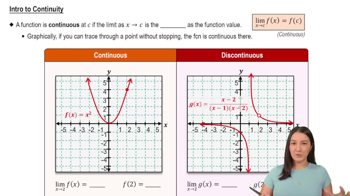
A function is continuous on an interval if there are no breaks, jumps, or holes in its graph. For a function to be continuous on the entire real line (-∞, ∞), it must be defined at every point and the limit of the function as it approaches any point must equal the function's value at that point. This concept is crucial for understanding the behavior of the function across its domain.
Recommended video:
05:34
Intro to Continuity

First Derivative and Monotonicity

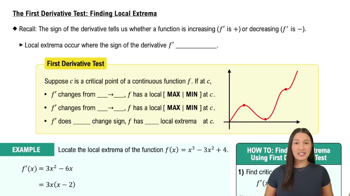
The first derivative of a function, denoted f'(x), indicates the rate of change of the function. If f'(x) > 0 for all x in the domain, the function is increasing everywhere. The existence of points where f' does not exist, such as at x = -2 and x = 1, suggests potential vertical tangents or cusps, which can affect the overall shape of the graph.
Recommended video:
07:09
The First Derivative Test: Finding Local Extrema

Second Derivative and Inflection Points

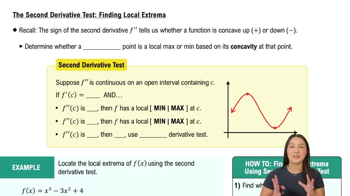
The second derivative, f''(x), provides information about the concavity of the function. If f''(0) = 0, this indicates a possible inflection point at x = 0, where the concavity may change. Understanding the second derivative is essential for analyzing the curvature of the graph and predicting how the function behaves around critical points.
Recommended video:
06:02
The Second Derivative Test: Finding Local Extrema